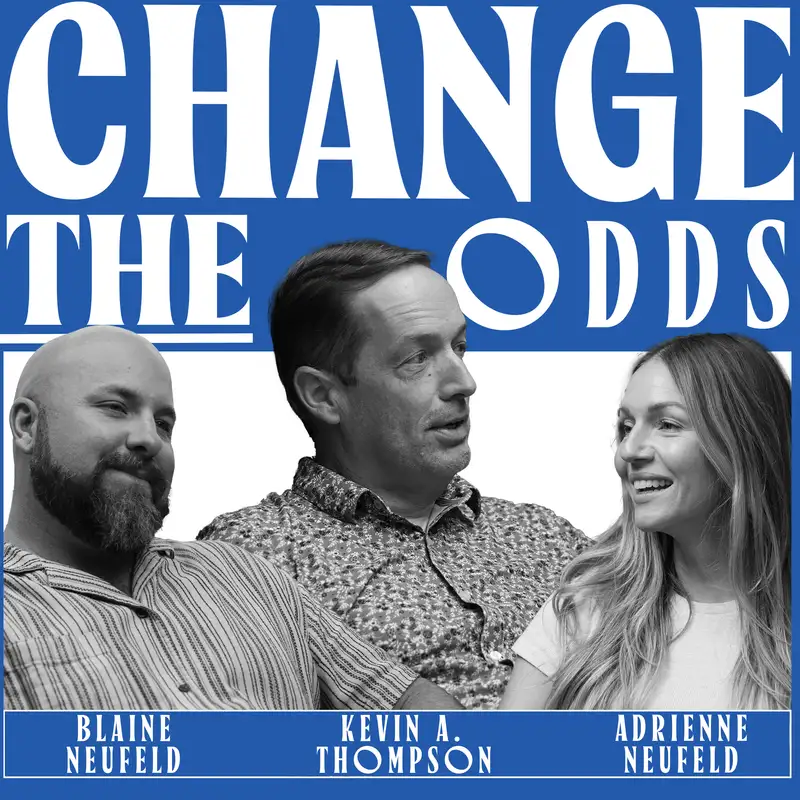
Kevin Thompson [00:00:00]:
Hey, welcome back to Change the Odds, the podcast where marriage and family were not, what?
Blaine Neufeld [00:00:04]:
Meant to be a game of chance.
Kevin Thompson [00:00:05]:
Oh, my goodness.
Adrienne Neufeld [00:00:07]:
They did it.
Blaine Neufeld [00:00:07]:
Well, we're getting into the holiday season. I'm taking things a bit more serious. I love this time of year.
Kevin Thompson [00:00:11]:
We look festive.
Blaine Neufeld [00:00:12]:
Love this time.
Kevin Thompson [00:00:13]:
Together we are Christmas.
Blaine Neufeld [00:00:14]:
Yes.
Adrienne Neufeld [00:00:15]:
Okay.
Kevin Thompson [00:00:16]:
And then Scrooge over here.
Blaine Neufeld [00:00:18]:
There's Scrooge. Yeah. That actually makes a lot of.
Kevin Thompson [00:00:23]:
Is it symbolic? Is it metaphor? Is that what's going on here?
Blaine Neufeld [00:00:25]:
Oh, yes.
Kevin Thompson [00:00:26]:
What.
Blaine Neufeld [00:00:27]:
What's your favorite Christmas movie, Kev? What are you gonna do a movie guy?
Kevin Thompson [00:00:30]:
No.
Blaine Neufeld [00:00:30]:
You're not really movie guy. You know that I'm asking the wrong guy here.
Kevin Thompson [00:00:33]:
Yeah. So, I mean, obviously Jenny loves Christmas vacation every year, and it bores me. I'm like, whatever.
Blaine Neufeld [00:00:39]:
You don't get the humor.
Kevin Thompson [00:00:40]:
No, not really. Not really.
Blaine Neufeld [00:00:42]:
I don't.
Kevin Thompson [00:00:43]:
I don't. I.
Blaine Neufeld [00:00:44]:
Stupid humor.
Kevin Thompson [00:00:45]:
I feel like we need to start over because I'm very nervous about it being known out there that we're not going to, but that I don't like Christmas vacation. Oh, that's a whole. I feel like I'm gonna be judged. Oh, really?
Adrienne Neufeld [00:00:54]:
Will be.
Blaine Neufeld [00:00:55]:
Yeah, yeah.
Kevin Thompson [00:00:56]:
Like, there's a social pressure that you have to like this movie.
Adrienne Neufeld [00:00:58]:
Kind of a cult classic.
Blaine Neufeld [00:00:59]:
What's interesting is what I'm learning is age, demographic matters on this movie, too, because the younger generation. Younger generation, like me. Yes. Young and hip. They don't know the movie. All right. Yeah.
Kevin Thompson [00:01:12]:
So I want to know on the comments, if you're watching. On YouTube or Apple, wherever you are, go the comments. And if you hate Christmas vacation, let me know.
Blaine Neufeld [00:01:19]:
Yeah.
Kevin Thompson [00:01:19]:
Because I don't want to be alone.
Blaine Neufeld [00:01:20]:
Hate is a strong word, but.
Kevin Thompson [00:01:21]:
So in Canada, is that a thing or not?
Blaine Neufeld [00:01:23]:
Christmas vacation or movies in general? The movies in the Joy of Christmas. Yes, absolutely. Yeah. Yeah, we. Yeah, we.
Adrienne Neufeld [00:01:31]:
That's our holiday in Canada.
Blaine Neufeld [00:01:32]:
I just built a playlist. You know, we got the kids at home. We got the young kids at home. So I built a playlist with roughly about 20 Christmas movies that.
Kevin Thompson [00:01:41]:
Oh, there you go.
Blaine Neufeld [00:01:41]:
Now it's going to take a lot of the stress out of the evenings of. Can we watch something? Yeah, absolutely. What are we going to watch? We got our list.
Kevin Thompson [00:01:48]:
Brilliant. Look at you showing it. Initiation initiative.
Blaine Neufeld [00:01:51]:
Thank you.
Kevin Thompson [00:01:51]:
Intention. I was inspired by chapter one of Friends Partners. Very well done.
Blaine Neufeld [00:01:55]:
Wow.
Kevin Thompson [00:01:58]:
Love that chapter.
Kevin Thompson [00:02:00]:
Oh, he pretends like he's read it. Okay. All right, what do we got today? We got. All right, we're back into Fight Club.
Blaine Neufeld [00:02:06]:
We're fight clubbing.
Kevin Thompson [00:02:07]:
But now it's Holiday Fight Club.
Adrienne Neufeld [00:02:09]:
Holiday Fight Club.
Kevin Thompson [00:02:10]:
Not that that really happens very much.
Adrienne Neufeld [00:02:12]:
We need like a jingle bell.
Blaine Neufeld [00:02:14]:
Instead of a ding, ding, ding, it's a ring, ring, ring.
Kevin Thompson [00:02:16]:
Oh, there you go. Look at that. Blaine's firing on all.
Blaine Neufeld [00:02:20]:
I'm going here. Bringing the energy. Holiday season.
Adrienne Neufeld [00:02:23]:
Okay, I got a letter from the couple.
Blaine Neufeld [00:02:26]:
Okay. The couple.
Adrienne Neufeld [00:02:28]:
You ready? This is going to be a doozy. Okay. Dear change the odds. My husband and I love each other, but every December, we hit the same wall. We've been married for five years. Aww, babies. And each Christmas turns into a tug of war with our families. The biggest struggle is with my in laws.
Adrienne Neufeld [00:02:46]:
His mom expects us at her house all day on Christmas every year. If we suggest splitting the day or visiting my family, she gets quiet and hurt. My husband feels guilty and insists we should just keep the peace by going along. Meanwhile, my own parents feel.
Kevin Thompson [00:03:02]:
I feel like there was some judgment in that reading.
Adrienne Neufeld [00:03:04]:
I just relate.
Kevin Thompson [00:03:05]:
I'm sorry.
Adrienne Neufeld [00:03:06]:
Meanwhile, my own parents feel slighted that we barely see them. I end up feeling like I'm competing with his mother for his time and loyalty. It's reached the point where I'm starting to dread the holidays. Feel ya, girl. To make things harder, when we're with his family, I often feel disrespected. His mom has a habit of making little comments about how I set up our home or raise our kids. My husband swears she means well and tells me not to take it personally, but it hurts, and I feel he doesn't stand up for me. Instead of enjoying Christmas as a couple, we end up arguing in the car on the way home from his parents.
Adrienne Neufeld [00:03:39]:
He accuses me of overreacting to his family, and I accuse him of not having my back. By New Year's, we're barely speaking. Yeah, we are exhausted and heartsick. We know this isn't how we should be handling family or each other. We don't want to ruin another Christmas with the same fight. Sincerely torn between families, between two fans.
Blaine Neufeld [00:03:57]:
It's fun that, you know, the Christmas season's supposed to be all about joy, but it is misery. It can be. It can be.
Kevin Thompson [00:04:05]:
It doesn't have to be misery, but it can.
Adrienne Neufeld [00:04:08]:
It's like going to Disney with your dreams. Happiest place on earth. And everyone's angry there.
Kevin Thompson [00:04:13]:
Well, and I do think there's a lot of correlation between that. I think one, the expectations. So there are these expectations in which just people think, oh, this is supposed to be the best time of year, so we shouldn't have any stress. So whenever they do, they feel like they must be doing it wrong. But then you just have all the family dynamics that are totally. That's what happens at Disney. That's. Now what's gonna.
Kevin Thompson [00:04:31]:
I assume I'd rather been, but that's also.
Adrienne Neufeld [00:04:33]:
You've never been.
Kevin Thompson [00:04:34]:
No. You've never been.
Blaine Neufeld [00:04:35]:
Christmas vacation.
Adrienne Neufeld [00:04:36]:
Hey, who is this guy? A fun sucker.
Blaine Neufeld [00:04:39]:
2026 is a big year for Kevin. We taking them. Let's take the podcast.
Adrienne Neufeld [00:04:44]:
I know. Watch Christmas vacation.
Blaine Neufeld [00:04:45]:
Let's take the podcast on the lounge.
Kevin Thompson [00:04:47]:
Christmas vacation. What if we're going to enjoy it? Let's do that. Let's do that. Hey, if anybody from Disney's watching, we'd love.
Adrienne Neufeld [00:04:51]:
We'd love a sponsorship.
Kevin Thompson [00:04:52]:
We'd love a sponsorship. All right, so let's talk. We got two issues going on here. We might only have time to deal with one of the two, but I definitely want to come back at a later time to deal with the second. And the second is the sense in the letter of the criticism. Okay? So that now is what feels like the mother in law is not loving and supportive of the daughter in law, and the husband is trying to navigate that and manage all that. So I think that's an important element. If we get to it, that'd be great.
Kevin Thompson [00:05:17]:
I wouldn't be surprised if, time wise, we don't, because we have this first issue that the writer presents in this, and that is, where do you spend time during the holidays? And how do you navigate that in a proper way? And then beyond that, the emotions that are on the other side of what's going on. All right, so let's look at a couple possible personality things that are taking place here. Doesn't mean it's always necessarily the case. But think about this. Whenever we think about our fight club, how do we navigate this? The first thing we want to start looking at is what are the attachment patterns that we bring in? Right? So we call those our love styles. That's how we interact with love. What are the personality things that we bring in? We call those our lead styles. This is just where our energy just naturally begins to flow.
Kevin Thompson [00:06:02]:
And then we look at how those begin to play off of each other. What's the dynamic that's there? So all of that is the autopilot by which we operate in, and these issues just begin to trigger those things. And so a couple possible kind of lead styles that could be happening here. You could have the concept whenever it talks about. He just wants to Keep the peace and that kind of thing. Adrienne, this reminds me a lot of your kind of personality, of this agency dyadic. So he's keenly aware of what his wife feels, what his mom feels, of what he feels. And the tension within all that can be overwhelming to him.
Kevin Thompson [00:06:40]:
So he just wants to keep the peace, whatever it actually is now. So if he's coming in with that agency dyadic kind of viewpoint, it wouldn't surprise me at all if she might be coming in with this bonding outward. So she is also keenly aware of all relationships, of what's taking place, but a little bit more of an outward perspective. So this would be like an enneagram 2 and an enneagram 9. That they're coming in now and having these different feelings. And she now, in this relationship, could feel like her work isn't being appreciated. She's doing all this stuff, trying to make sure everybody's happy, and he's not valuing that. And so she now feels that.
Kevin Thompson [00:07:19]:
And then he just feels this tension of what's going on in the midst of the relationship. And so she's wanting connection. That's the bonding aspect. She wants connection. And yet he's more concerned about keeping the peace of everybody else and not the actual kind of connection that's actually there. Do y' all sense any of that? Yeah.
Blaine Neufeld [00:07:40]:
Yeah. I mean, I always just analyze my own life through these fights and all these things like that. Cause it's so relatable. But it's like going into.
Blaine Neufeld [00:07:50]:
And going into keeping peace, and she's doing the opposite, or. No, she's keeping the peace.
Adrienne Neufeld [00:07:55]:
No, he is.
Blaine Neufeld [00:07:55]:
Right?
Kevin Thompson [00:07:56]:
He is. She's looking for relationships. Because notice what she said in there is, I want to be with my family too.
Blaine Neufeld [00:08:00]:
Right.
Kevin Thompson [00:08:01]:
So notice the relational bonding that she desires. And he's not really paying attention to that. He's much more on just what's going to keep everybody generally happy. So she is now feeling his apathy as a rejection for her desire for connection.
Blaine Neufeld [00:08:18]:
Right. Any thoughts?
Kevin Thompson [00:08:20]:
Whoa.
Adrienne Neufeld [00:08:21]:
I think this is funny because the roles are reversed. I'm the keep the peace. Let's make everyone happy. And you're like, let's have the best time. Let's not see what else is going on in the room.
Kevin Thompson [00:08:32]:
Let's live in denial of all the tension.
Adrienne Neufeld [00:08:36]:
He's just. He's in the moment. He's very in the moment. We're gonna make the best of this moment.
Kevin Thompson [00:08:40]:
So agency outward.
Blaine Neufeld [00:08:41]:
Yeah.
Kevin Thompson [00:08:42]:
Right. So it's really about you're having. And then all the things that are happening, it's all good. Could be missing some of the relational dynamics.
Blaine Neufeld [00:08:49]:
Totally.
Adrienne Neufeld [00:08:50]:
But I feel the tension.
Kevin Thompson [00:08:51]:
Yes, right. We call that the under the table experience. Right. You're just, you're viewing what's happening around this under the table. Adrienne is keenly aware she's dying inside the fists that are underneath the table that are clenching in this moment, kicking him.
Adrienne Neufeld [00:09:04]:
Look alive.
Kevin Thompson [00:09:05]:
No, that's exactly right. No, that's exact.
Blaine Neufeld [00:09:08]:
Right. So she, so he. Is he like avoiding at all or like the unknowingness or.
Kevin Thompson [00:09:14]:
It sure sounds like it, it sounds like if we're looking at from. Right, so love styles and attachment approach here. It sounds like he's gonna be a little bit more avoidant and she could, could be a little bit more anxious now. Now it could be. What's going on here is he might be anxiously attached to his mom and so he is now trying to manage her emotions and her feelings. So he could actually have somewhat of a secure attachment with his spouse and but is anxiously attached with his mom and can navigate that well generally. But in a moment of stress, he then goes down that more non secure pathway to where he's now protecting the one he's anxiously attached to at the expense of the one he's actually attached to.
Blaine Neufeld [00:09:51]:
It's interesting too because when she says like, we don't or we, you know, we'll fight until New Year's. So it's like this is an ongoing thing. This is a, you know, it's seemingly a year after year after year and it's only going to build if you don't solve some of this.
Kevin Thompson [00:10:07]:
I mean, you would almost feel like I could be wrong, but you can almost get the sense of like an earthquake where you have these two right. Plates that are pressing against each other throughout the year and they're just slowly starting to press. And then all of a sudden, as the holidays are coming, you can feel the fractures about to happen. The earthquake is now going to take place. And if you're not careful about this, here's what happens is it becomes your pattern so that your body begins to prepare for what's about to take place, which actually causes it to take place even more. And so this is one of these reasons the earlier. And I love this, five years in, this is not surprising at all. Five years in, all right? This is the time to deal with this.
Kevin Thompson [00:10:48]:
Because if you can learn to deal with this now, think about how many Christmases and Thanksgivings do you have in front of you and how Much calmer you can actually be. There is one personality switch we could make here, and that is we could easily put Jenny and I into this role. So think about Jenny now with an agency, inward kind of mindset, like an enneagram one. I'm certainty dyadic, so more an enneagram six. Right. So those two things could be coming in. So it could be like if this were Jenny. I don't think it is.
Kevin Thompson [00:11:15]:
If this were Jenny writing this letter. It is. Man, I want to have all these experiences. I want to do these things. I want to experience Christmas the way I'm supposed to experience Christmas. I hope everybody else does as well. I'm doing all the work to make everything right. And I'm over here now a little bit too concerned, predicting possible tension and having a great sense of all the relationships that are going on, much like Adrienne would have.
Kevin Thompson [00:11:35]:
Then I'm like, ooh, let's not do what you want here, because that might cause a little bit of tension. I'm uncomfortable with that. And then especially if you have an anxious either. Either non secure pathway that's going on, I'm not gonna be able to handle that tension in a proper way. So I'm gonna try to prevent it from happening. Go ahead.
Adrienne Neufeld [00:11:52]:
Well, because I feel the same way, I would rather prevent the tension now, if tension arises, is that okay?
Kevin Thompson [00:12:00]:
Yes.
Adrienne Neufeld [00:12:01]:
And like.
Kevin Thompson [00:12:02]:
Yes.
Adrienne Neufeld [00:12:03]:
Is it okay? Like I don't even know how to sit in tension.
Kevin Thompson [00:12:06]:
Yeah. Oh, that's a. That's a great thing. That's. That's a great. A great awareness of yourself. I love that. And so now it's time to start recognizing.
Kevin Thompson [00:12:15]:
How do I do that?
Adrienne Neufeld [00:12:16]:
Yeah.
Kevin Thompson [00:12:16]:
And so think about what we've talked about before. Of again, if we begin to see all nine of these pathways of personality, you can use the enneagram. You can use something else as tools. Now what you could begin to do is to say, all right, as an agency dyadic, as an enneagram9, man, I have this great skill of recognizing of that dyadic viewpoint. I can see what everybody else is going on. I'm keenly aware of myself as well. Now, however, a nine doesn't sit well intentioned. So when tension arises, my nine ness is going to try to piece everything right.
Kevin Thompson [00:12:52]:
Sometimes I don't need to do that. What would it look like now to leverage a little bit more of a four and to go, all right, what does this look like? And man, to have some mourning of the brokenness of man. It's sad that this tension is happening, but you can actually feel it. You're going to upregulate it a little bit. Instead of shifting into peace.
Adrienne Neufeld [00:13:11]:
Or avoiding.
Kevin Thompson [00:13:11]:
Yeah. Or avoiding. Or even the idea of being able to recognize what is it about this tension that bothers me. It makes me angry. There's actually a frustration that's underneath that, and that's okay. To deal with the frustration that is there. That's a beautiful thing to begin to train yourself whenever you feel it, to recognize. All right.
Kevin Thompson [00:13:31]:
I tend not to do well with this. What would it look like? Literally, you get the image of, I'm going to sit in it.
Adrienne Neufeld [00:13:36]:
Well, it gives me anxiety.
Kevin Thompson [00:13:38]:
But to do it in short spurts. Maybe you could even have a chair in your house and. All right, that's the chair. I'm gonna go sit in this for a moment, and I'm literally gonna walk over and sit down and begin to process what's going on. My heart rate might begin to rise a little bit again. Let's go back to our episode on the Window of tolerance. You're gonna stretch your window of tolerance here a little bit by sitting in this muscle so that whenever you experience it, you're a little bit better prepared instead of just training yourself to run in some way.
Blaine Neufeld [00:14:08]:
I love that, and I think it's great. I also am curious about. We don't answer this question, but there's going to be so much stress moving into the holiday season even before they get there. But if there is a secure attachment between husband and wife and they can start to dialogue about what we're about to go into, because I know for us, these good seasons that we're in, we get to now talk about an upcoming thing or an upcoming idea of work or whatever. And it's stressful. Yes. But because we're able to have a secure attachment of honesty and.
Kevin Thompson [00:14:39]:
No.
Blaine Neufeld [00:14:39]:
Are you okay? No, I'm stressed. Oh, why are you stressed? Let's talk about it. Because it's a safe place to build some actual.
Adrienne Neufeld [00:14:46]:
And practically. It's like, we deal with this because when we go home for holidays, we have both our families in the same town.
Blaine Neufeld [00:14:52]:
Yeah.
Adrienne Neufeld [00:14:52]:
So we have to split time.
Blaine Neufeld [00:14:54]:
And it's.
Adrienne Neufeld [00:14:54]:
It's hard to figure out.
Blaine Neufeld [00:14:56]:
And the irony is everyone wants to be with everyone. Everyone wants to have fun. They all love each other and us and all the things. And then it's like, there's just not enough. Right. And you have made a question or a point of, like, what's the expectations? The question, before we even get into this, that I have that. I think you're the expert. You've got great wisdom.
Blaine Neufeld [00:15:15]:
It's like, before you get married, three years into marriage, what is the best strategy to, like, dialogue about what your expectations are about Christmas about. So you create this secure attachment to know I'm going into a war, and I know the rules of the war.
Kevin Thompson [00:15:32]:
Right? Like, well, even. I mean, just last month we taught our premarital class here that we do, you know, three or four times. And one of the things that we talk about is, what does Christmas mean to you? Christmas Eve. I'm going to say Christmas Eve, you both jot down what that means to you, and then you begin to compare and recognize. Oh, you come in with different expectations. And so, I mean, one of the fights that we'll get to hopefully this month is they were talking about how his family's small and quiet. My family's huge and fun. And the expectation is his family should be more like mine.
Kevin Thompson [00:16:04]:
Well, is it possible that he's stressed out at your house? Because it's overwhelming. And so even to recognize. So think about this. Jenny's family again. The very first holiday we ever spent together was Thanksgiving. And we went to her place, and they rent out the community center, and there's 80 to 100 people that are there that are all. They're all family. They're all family.
Kevin Thompson [00:16:28]:
This was Thanksgiving. They do the same thing for Christmas. So literally, I show up, right? We're in rural Oklahoma. I'm the city boy, right? And so I'm thinking to myself, how am I going to talk to these guys? It's hunting season. I don't.
Blaine Neufeld [00:16:40]:
You don't? Really?
Kevin Thompson [00:16:41]:
I can't. I mean, look at these hands. They've done nothing.
Blaine Neufeld [00:16:44]:
I'm a good punter, though.
Kevin Thompson [00:16:45]:
Here's my plan. So I'm pretty good generally with an elderly woman crowd, right? Those are my people, right? Those are my people. I love them. They love me. So here's my plan. Going in. Here's what I'm going to do to avoid the conversation about hunting and all that. I'm gonna go into the kitchen and I'm gonna serve, right? And so I went in the kitchen where we talked about hunting.
Kevin Thompson [00:17:07]:
No.
Kevin Thompson [00:17:10]:
So literally, so we go to that experience, eighty hundred people, right? The chaos that's there. We leave there to then go to my mom's side of the family. And so the first family experience, my Jenny, that Jenny really had for Thanksgiving was Thanksgiving night. I think there were nine of us around the very formal dining room, as quiet as could Be only one person talking at a time. So think about that contrast wild where.
Adrienne Neufeld [00:17:37]:
Those two sound kind of.
Kevin Thompson [00:17:39]:
Yeah. Adrienne doesn't want either one of them. No. But Blaine, I think to make your point is early on, as you're dating, as you're engaged, as you first get married, let's talk about what were the Christmases like growing up, what was your experience? And then to begin to recognize, hey, these are going to be different. Which do we value and how do we want to spend time in both of them?
Blaine Neufeld [00:17:58]:
Because the person that's trying to be a peacemaker or everybody happy and this, that that person typically just wants to know what's the parameters. You have to. As a spouse, you have to figure out how you're the first team and you're going into combat together. Because in your scenario, I think if Jenny knows that this is going to be anxiety filled for you, she can protect you you in the best way, especially if it's her family. And then vice versa. Of like vice versa. Vice versa.
Adrienne Neufeld [00:18:28]:
You always say vice, but it's vice versa. Right, Vice versa. Okay, what is it?
Kevin Thompson [00:18:32]:
I think it's vice versa. But yeah, he did say vice versa.
Blaine Neufeld [00:18:35]:
He's always making Italian. I like to go back to the origin. Origin.
Kevin Thompson [00:18:41]:
Hey, if you're watching right now on YouTube comment, is Blaine an idiot or.
Adrienne Neufeld [00:18:45]:
Is it vice versa?
Kevin Thompson [00:18:47]:
Is he actually right, Adrienne over here judging him?
Blaine Neufeld [00:18:49]:
Thumbs up for idiot.
Kevin Thompson [00:18:53]:
No.
Blaine Neufeld [00:18:54]:
Yeah. But anyway, just to, to know, I think that's a cool strategy of like attacking it together because as that person's trying to make sure everyone's happy and the secure attachment is suddenly is not so secure. It's like, dude, you're going to ruin all the fun.
Adrienne Neufeld [00:19:09]:
Yeah. And there's no worse feeling than going into a family gathering and feeling alone when it's not your family and feeling.
Blaine Neufeld [00:19:18]:
Like I feel lost to your point of not hunting. Our family talks Sports, sports, sports. Adrienne was sitting at the table one night and we're just talking. She's like, you guys are truly talking in another language.
Kevin Thompson [00:19:29]:
Yes.
Blaine Neufeld [00:19:29]:
I don't know what you're saying. I zone out and then. But it's like, you know what's going on? Why aren't you talking? I don't know what you're saying. Yeah, but if the husband or the spouse knows that and can bring her along into some of that but she knows what she's going into and the family knows what they're bringing. You know what I'm saying?
Kevin Thompson [00:19:49]:
No, I think that's a great point. I think to Watch out for your spouse.
Blaine Neufeld [00:19:52]:
Sure.
Kevin Thompson [00:19:52]:
In the other scenario. But Blaine, I think you also point out if we're going to kind of begin to diagnose some problems that are going on here. You point out the first one that I think is very obvious. And it is this idea of they're not tackling this problem together. I love it that they're coming at it individually and literally. Here's what happens. Whenever we come at problems individually and not as a couple, eventually the problem becomes our spouse, not the actual issue.
Blaine Neufeld [00:20:16]:
Why aren't you doing this?
Kevin Thompson [00:20:17]:
What they need to do at this moment is literally, let's get on the same side of the table, point at the issue over there and go, how are we going to come after that? A second issue that we can clearly see here is he is mistaking avoidance for peace.
Blaine Neufeld [00:20:29]:
Yes.
Kevin Thompson [00:20:30]:
So the outcome that he wants, which is peace, his actions to get that are preventing that. So he thinks, oh, if we can just keep things the way they are, everything will be peaceful. And it's actually creating this tension primarily for his wife, but he's experiencing that as well. So it's an interesting thing here and that we see this in non secure attachment, that what you desire, the actions that you're taking to get that outcome, are actually preventing that very outcome. If he would actually lean into this, he would end up getting the peace that he actually wants. So don't forget this whenever we talk about love styles. With an anxious attachment, you need to stop reaching as much. With an avoidant attachment, you need to lean in when you're tempted to lean out.
Kevin Thompson [00:21:11]:
And so here he needs to lean into a conversation that he tends to be running from and that will get the outcome that he wants. But there's actually a bigger issue here at play that I don't know if y' all have seen this or not. Here's what's happening in this moment. There is this triangulation that's happening. So there's a triangle that's taking place at this moment. Right. And it's a problem because this primarily is not supposed to be an issue involving a triangle. This is an issue for a dyad, a couple, two people are involved, a husband and a wife.
Kevin Thompson [00:21:44]:
But notice what's happening here. Mom's involved. Right. And so this is a very common scenario that we see. It's not just with in laws by any means. Not just the typical mother in law is the picture that many people get. But there's a big term that I want us to begin to recognize and maybe you can Come up with a different phrase that's a little bit better, but it is this idea of triangulation. Triangulation is whenever.
Kevin Thompson [00:22:10]:
Let's start with a couple, Then we can look at this in other relationships. Triangulation is when a wife and a husband, rather than dealing with the issue between them, they allow the uncomfortableness or the anxiety to let them bite to a temptation of, we're gonna use somebody else to navigate this. So instead of, hey, I'm gonna have a conversation with Jenny about this. It's gonna be tense, but we're gonna lean into it. This is really about me and her. Instead of doing that, I can be like, hey, Silas, go tell your mother what's going on. Or I'll lean in and begin to value my mom's feelings over Jenny in the moment. And the next thing you know, you bring in to the dyad relationship.
Kevin Thompson [00:22:56]:
You bring into the husband and wife this third party that is now having an influence that they actually shouldn't begin to have. And now you literally have a triangle where instead of dealing with each other, there's this third party that's impacting what's going on. And this now can create some very toxic situations. So triangulation is something every couple needs to be aware of. Have you ever heard of that phrase?
Blaine Neufeld [00:23:20]:
Never heard of it.
Kevin Thompson [00:23:21]:
Have you experienced it?
Blaine Neufeld [00:23:22]:
Yes.
Adrienne Neufeld [00:23:24]:
Very familiar with it.
Blaine Neufeld [00:23:26]:
Different than, I mean, I don't want to counselor third party.
Kevin Thompson [00:23:31]:
So it's interesting because a counselor has to work very hard not to become this. So in a healthy counseling situation, and the counselor being very skilled, each party will attempt to triangulate the counselor. Because one way to look at this is if I can get the counselor on my side.
Blaine Neufeld [00:23:50]:
Yes.
Kevin Thompson [00:23:50]:
So some people go to counseling with the hope of triangulation. In that I'm going to go and the counselor is going to tell my spouse what they're doing wrong. Well, what you're trying to do is to get the counselor on your side. Now, that's an unhealthy relationship. Counselors are very skilled to prevent you from doing what you want, because that's not the ultimate goal. But, yeah, we can do it with a counselor. We see it within. Obviously, parents are a very common thing where a spouse aligns with their parent rather than their partner.
Kevin Thompson [00:24:20]:
You can do this with kids very easily. The example I just gave, instead of a couple now navigating their issues, it literally becomes, hey, go tell your father this. Which, there's nothing wrong with that. Like, dinner's ready. Go tell your father nothing wrong with that unless you're doing that because you don't want to go talk to him. Well, now what are you doing? You're using the child to navigate the anxiety of what is actually taking place. This happens in workplaces all the time. In which you can now try to get a boss to triangulate in what's going on.
Kevin Thompson [00:24:50]:
How often have you heard this? How often have you gone to your boss and said, hey, all these people.
Blaine Neufeld [00:24:54]:
Are saying yes, Right?
Kevin Thompson [00:24:55]:
Okay. So instead of dealing with the issue directly, you're trying to triangulate other people in to get them to make the issue look like it's bigger than it actually is, because you can't confront the issue for what's actually going on. Triangulation actually keeps us from solving problems and from doing what we want. So anytime.
Kevin Thompson [00:25:15]:
Anytime you get this idea of, hey, can you go talk to them? For me, that's a sign of triangulation is happening whenever it becomes the idea of their feelings matter more and they're impacting what's going on between us. That's a matter of triangulation as well. And so let's look at what's happening in that moment. So an avoidant partner oftentimes will try to triangulate because they're looking for calm, looking for escape. So how do I keep this peaceful? So literally in this letter, it's, hey, mom. You know, mom's doing this, so I'm gonna defer to her in order to keep peace. I'm gonna triangulate. I'm not gonna show.
Kevin Thompson [00:25:51]:
Hey, me and mom have two votes. You have one that's gonna keep the peace, right? And we're gonna be good. What an anxious partner tends to look for is either relief or validation. So it then becomes, hey, I want the counselor. Let's go to counseling so that the counselor can tell you what you're doing wrong. So now that validates how I'm actually right. Now, there's nothing wrong with this, but in part, we're actually inviting people to do this. This person writes the letter primarily because they want us to tell their spouse how wrong they are.
Blaine Neufeld [00:26:21]:
Right? We are. Now the triangle is in the triangle. Oh, my gosh. There's a lot of layers, in part.
Kevin Thompson [00:26:29]:
That is kind of going on to someone, but all of it's about regulating and anxiety that the couple themselves are now unwilling to actually deal with. So here's something I want us to think about, and then we'll get back to. To the letter in that we need to learn within our own relationships, not to triangulate.
Blaine Neufeld [00:26:46]:
Right.
Kevin Thompson [00:26:47]:
And so what does that look like? Well, first of all, the language that you now have is going to be useful. You're going to start seeing this. No, far more.
Blaine Neufeld [00:26:55]:
Yes.
Kevin Thompson [00:26:55]:
You already see it, but now you have language.
Blaine Neufeld [00:26:57]:
Yeah.
Kevin Thompson [00:26:57]:
You're going to be able to point at your friend. Oh, my goodness.
Blaine Neufeld [00:26:59]:
Just like when Adrienne was her window of tolerance. Drinks at home and the family fights. I can tell the kids in her. Her windows now.
Kevin Thompson [00:27:08]:
Be careful.
Blaine Neufeld [00:27:10]:
We're in a triangulation.
Adrienne Neufeld [00:27:13]:
Can you say it?
Kevin Thompson [00:27:14]:
What?
Kevin Thompson [00:27:17]:
You know, vice versa.
Blaine Neufeld [00:27:19]:
It is vice versa.
Kevin Thompson [00:27:20]:
So we want to be careful about that. So let's name it. And then whenever we begin to see it within ourselves, let's return as a couple and basically try to exclude the third party.
Blaine Neufeld [00:27:31]:
Right.
Kevin Thompson [00:27:32]:
Let's come back together and literally, let's sit on the same side of the table, let's look at the problem that's over there and go, how can we attack this together? Rather than, you're on that side, I'm on this side. Who can I get on my side to help this? Or who can we navigate?
Blaine Neufeld [00:27:46]:
Can I stop us there? Because I think it's a massive point. How do you do that? When you see a scenario and you're trying to get someone else on your side, you clearly. The two of you clearly are not seeing it the same way. What is the first step for someone struggling to start to. I'm assuming there's a little bit of humbleness and humility that has to happen. But how do we.
Kevin Thompson [00:28:09]:
Let's sit down at the table together. Let's scoot our chairs closer together than what we normally would. Let's not be opposing each other. Let's physically get side by side, let's get a sheet of paper, and let's write about everything we have in common about this issue. So don't start with the differences.
Blaine Neufeld [00:28:24]:
Right.
Kevin Thompson [00:28:24]:
Start with the differences. Instead, start with, what do we have in common? Let's go with this letter. What do we have in common? We both want a happy Christmas. We both want our. We want to connect with our families. We want to connect with each other. We want. In the future, we want to start setting traditions now at five years.
Kevin Thompson [00:28:40]:
In that 20 years from now, we can. Some of the things that we're doing are the same. I don't know if there's kids involved here, but what kind of household and Christmas party and celebration do we want our kids to experience in the years? Let's begin by everything that we share, because here's what happens. We tend to start with differences. And the moment we start with a difference, then that separates you from me. And now it's who's right and who's wrong. But whenever we start conversations with similarities, hey, what do we share here? Okay, then once we actually get to a difference, that is one difference in the list of 100 things we already have in common, well, suddenly that difference isn't that big of a deal. And so let's start writing down what are the shared values that we have?
Blaine Neufeld [00:29:25]:
I love that.
Kevin Thompson [00:29:26]:
And then from that, then, all right, how can we begin to meet those? And how instead of it being either or, either you can be happy or I can be happy. Those are only options. No, no, no. What's a both and look like? How can we both experience. What do we want? What would it take for you to experience a happy Christmas with your family? Here's what I want for my family. Here's what you want from your family. It's never going to be perfect, but I bet you we can do a lot.
Blaine Neufeld [00:29:49]:
Yeah, I love that. Yeah. And I think about the prehab, like you said before, writing down your expectations to avoid this step. But it's never too late when you're in the fight and then in the season, and it's like, hey, when October had hit or November had hit, Christmas is coming. We know it's coming. Let's write out what we dream about, having a great Christmas united as a couple, and then we'll go after it together.
Kevin Thompson [00:30:13]:
Yeah, no, absolutely. So. So let's get back. A couple things to avoid. We want to name what's actually going on. Don't get caught up into it without language. We want to return as a couple, so let's exclude the third party for a minute. Let's begin to set true boundaries around influence.
Kevin Thompson [00:30:28]:
We'll get to that in just a moment with some stay in your lane concepts. But we got to own what belongs to us and not allow somebody else to say what's going on. And then let's make sure that we're asking even the right questions again. If we're sitting on the same side of the table and we start with what we have in common, we're going to move beyond the question of who's right, because a lot of the questions we get sent in, and we want you to send in that question, that way we can correct you. But the issue is not who's right, it's what do we want for our family? How are we going to move forward now? So I think this is an important Part here, that here's what's really going on. This isn't just about his mom. This truly is about a triangle that's taking place. And whenever triangulation happens, it's when a couple can't really handle the tension that's between them.
Kevin Thompson [00:31:12]:
So what they do is they bring a third party into it. And so in this case, it says, mother doesn't have to be. Don't get caught up by the gender. It could be a father, it could be a child, could be anybody else. But he uses her expectations to avoid his wife's disappointment. And then she uses her frustration to force him to choose of what's actually going on. But every time you pull somebody else into the middle, you lose the intimacy that you actually want. Because the thing third party, cannot be a part of the intimate relationship of what is actually taking place.
Kevin Thompson [00:31:42]:
So the way out of a triangle is simple. It's not easy, but it's simple. And that is, you've got to walk back toward each other, talk directly, set boundaries. You can't have unity if you're constantly outsourcing your piece to somebody else or expecting somebody else to even navigate your anxiety. Instead, when two people are willing to actually sit in the tension together, the next thing you know, they can navigate that, and then they can go out and deal with the other parties. So let's talk about this from a stay in your lane kind of concept, because I really do think that's the answer here. It's more than just a book plug.
Blaine Neufeld [00:32:14]:
It always is.
Kevin Thompson [00:32:15]:
You know, Adrienne, you know where stay in lane is available? We're all fine. Books are sold, including online.
Adrienne Neufeld [00:32:21]:
I wasn't wondering, but thanks.
Kevin Thompson [00:32:22]:
What?
Blaine Neufeld [00:32:23]:
We have too many copies.
Kevin Thompson [00:32:24]:
Yes, but I think you've heard it too much. Right. So let's get back. Stain your lane. What's mine, what's theirs, what's God's. So in this case, what's mine really could also be what's ours. So as a couple, what is it that we actually hold onto? So think about this. What do they hold on to? Where they spend their holidays, how they divide their time, the rhythms that begin to work for them.
Kevin Thompson [00:32:46]:
What's happened here, however, is now they're allowing mom too much of a say in the decisions they're making. Matter of fact, they might be blaming mom and not recognizing they're the ones actually making the decision. Mom's not making the decision. They're making the decision. It's just that they're outsourcing this to Mom. And so that's Putting her in an unfortunate situation. Unfair. And then it's stripping them of their own autonomy, their agency of what's going on and can be really frustration.
Kevin Thompson [00:33:18]:
So what belongs what's theirs? In this case, the what's theirs question is, what's Mom? Her own emotions.
Kevin Thompson [00:33:25]:
The size, the hurt. Here's one thing I read I see all the time. I don't know if it's in this letter or not. Doesn't the mom have a right to be sad?
Blaine Neufeld [00:33:34]:
Sure.
Adrienne Neufeld [00:33:34]:
Yeah, totally.
Kevin Thompson [00:33:36]:
Christmas is different. That my child's not gonna be there. That the family isn't gonna. Doesn't she have a right to be disappointed? Yeah, absolutely. Matter of fact, you can validate that. But what you don't wanna do is now try to manage it or think it's your responsibility or even to think that it's wrong. Whenever I do a wedding, I stand in front of the couple and I talk to the couple, especially if it's a young couple. I talk about how excited they are and how joy filled and they can't wait.
Kevin Thompson [00:34:05]:
And, man, it's exactly the way it's supposed to be. And then I say, but you know, your parents right now are just as happy as you are, and they're heartbroken at the same time.
Blaine Neufeld [00:34:12]:
Right.
Kevin Thompson [00:34:13]:
Because things are changing and they have. You can actually hold two things at the exact same time. You can hold joy and grief at the exact same time. And that's what your parents are doing at this very moment. Well, okay, in this situation, to look at mom and to say, hey, man, I'm sorry, this has to be very difficult. And to give space now for her grief and not to shame her in it, but also not to feel like you have to manage it.
Blaine Neufeld [00:34:39]:
Yes.
Kevin Thompson [00:34:39]:
Because that's what happens a lot of times. That belongs to her, that doesn't belong to me.
Blaine Neufeld [00:34:44]:
Yeah. And then especially as the peacemaker, you're trying to guess how to solve that problem. And it's a problem you can't solve.
Kevin Thompson [00:34:50]:
It's not yours.
Blaine Neufeld [00:34:51]:
No, it's not yours.
Kevin Thompson [00:34:52]:
And trying to solve it will create the very outcomes you're trying to avoid.
Blaine Neufeld [00:34:57]:
Yeah, yeah, that.
Adrienne Neufeld [00:34:59]:
I had a thought too, where it's like, in, like, biblically, it's like, honor your father and mother. That's a command. But then also it also says, get married and leave your father and mother. And there's this tension of, like, how do you live in that with choosing your spouse but still honoring your parents?
Adrienne Neufeld [00:35:19]:
I don't know, it just feels really tricky.
Kevin Thompson [00:35:21]:
Yeah, yeah. And to recognize the tension that's within that. And here's the thing, I think sometimes we can even begin to ask questions of. You have to navigate this carefully. Depends on your relationship. But it wouldn't be if you're close enough with your in laws to even ask this question. Hey, you know, when you and Dave got married, what was it like with Dave's parents? Was that ever hard? Did you ever feel a tension of. Because here's the thing, we love you and we want to spend time with you, but I love my parents too, and we want to spend time with them.
Kevin Thompson [00:35:55]:
And sometimes we really feel torn and we feel like we're letting both of you down to begin to reveal your heart. Now, you can't allow them to come in and manipulate that or anything like that. But to begin to ask their experience, I think can be a positive thing.
Blaine Neufeld [00:36:11]:
So you need to be strong enough and secure enough in yourself. When you're talking about Adrienne. Go sit in the chair in the tension. Right. Sit in the tension. Learn how to kind of develop that muscle as a spouse. You need to now enter the tension with your spouse to be secure enough to live in the tension, to let you know that you're unified in going into more tension. I'm assuming there instead of this triangle, it's not, you know, if you're one versus one as a couple versus a couple, you don't want to overpower that person.
Blaine Neufeld [00:36:39]:
I'm assuming we also want a one on one connection with, let's say the mother in law in this scenario of son to mom, mother, daughter in law to mother in law as a seeker.
Kevin Thompson [00:36:51]:
Yeah. So it's not like couple verses. No, no, never, never verses.
Blaine Neufeld [00:36:56]:
No.
Kevin Thompson [00:36:56]:
We want to have a unified front.
Blaine Neufeld [00:36:58]:
Yeah.
Kevin Thompson [00:36:59]:
So it can't be a situation here that let's say the couple gets together, they have this discussion. It can't be a situation now where the son goes to his mom and goes, hey, Amy's decided we need to spend Christmas this way.
Adrienne Neufeld [00:37:13]:
Throws her under the bus.
Kevin Thompson [00:37:14]:
Yeah, that can't. That's triangulation as well. Now mom and I are blaming my wife to ease the tension that's actually between us. So we can't do that at the same time. So we need to have a united front, what we're saying. But there is a principle here that I think is very important. You are always the one that delivers bad news to your family. Never your spouse, never your spouse.
Kevin Thompson [00:37:38]:
Because let's face it, your parents are also your spouse's in laws. And that's a newer relationship that does not have the history, doesn't have the blood that's behind it. So we want to nourish that to the best of our ability. Now, there are these rare exceptions. Let's say there's an abusive relationship where now an adult child is trying to reconnect to the best of their ability with these parents. All right, that's afraid relationship here. The spouse might come in and be the middle person to protect and guard. But that's an unusual scenario.
Kevin Thompson [00:38:11]:
In typical situations, I have to be the one to deliver bad news to my mom and dad. Jenny has to be the one to deliver bad news. It's just my job to come along within Jenny's family and to have this relationship with her. Mom of man. Do you know how lucky I am for the daughter you raise and the relationship I get? And thank you for what you've done and what a privilege this family is and how beautiful this is? Hey, Jenny has something to tell you before I leave, but. No, but it really is. It can't be on me for that now. We're 25 years in.
Kevin Thompson [00:38:41]:
It's a different scenario for me and Jenny at this point. I think she could have difficult conversations with my mom or my dad, but she doesn't have to. Why I'm gonna have those because I want to nourish that relationship, because I want my parents and my wife to have the best relationship they possibly can. So as I'm nourishing that I'm. Then I'm gonna be the bad guy whenever I get the.
Adrienne Neufeld [00:39:00]:
Like a bit of a shield for your spouse.
Kevin Thompson [00:39:01]:
Absolutely.
Blaine Neufeld [00:39:02]:
I like that. And then the other. Like when you talked about the couple, the spouse is getting together and strengthening their connection by writing out the common things that they love about Christmas season. I'm thinking about relationships now, right? It's like if there's tensions in a family dynamic of any kind, can they not just sit together and say, what do we. You know, if the. Let's say we've gotten to a point where the tension is high. Everyone knows the tension is high, but they're saying, I want the best for both of us. Can we also just say, as a.
Kevin Thompson [00:39:34]:
Relationship, it depends on the family. Depends on how good the family is. I think. I think a generally healthy family is experiencing a little bit of tension. Yes, they can do that. Then there are other scenarios or.
Blaine Neufeld [00:39:44]:
I guess my question is, is that not even a part of a marriage? Like, their opinion of. Of the expectations of Christmas is a. It's still a family, but it's not our family. It's the family there. You know, I'm saying, like, yeah. How much do you bring in to your marriage?
Adrienne Neufeld [00:39:59]:
Yeah.
Kevin Thompson [00:40:00]:
I mean, different families will navigate that in different ways. I do. I have sat with. I'm not offering this service by any means. I have sat with families.
Blaine Neufeld [00:40:07]:
Yeah.
Kevin Thompson [00:40:07]:
To help them navigate some of the scenarios that are going on and to bring out some of these tensions that are taking place. So that's not unusual. If it gets to a certain place. To get some counseling in a family system actually can be a very useful process, because what happens is then you can get a third party that does begin to validate some of the tension that's going on and to help a family navigate kind of what goes forward. But what needs to happen here. Literally, if they would get back into controlling what's mine and influencing what's theirs and accepting what's God's, then what happens is they can care for mom's feelings without now trying to carry them on their own or to navigate them. They can honor their parents without now having to obey them because they're no longer children. They live in a different spot.
Kevin Thompson [00:40:54]:
So they can leave and honor at the exact same time. And ultimately what they can do is everybody can learn to love each other better. Right. And so let's go back to the letter as it came to us. What are some basic principles? We've kind of laid them out now, but what will this look like if they solve this? What will this look like? What it basically means is we can't write a prescription of you spend this many hours at his house, this many hours at her house. It's not about that. Here's the question. What would leave both of you feeling connected, first and foremost with each other and then with your families and your extended family as well? What would need to take place for that to happen? Now let's look at a scenario in which we try to accomplish all of those goals to the best of our abilities.
Kevin Thompson [00:41:40]:
Instead of it being a competition of either you get to connect with yours or I get to connect with mine. Because there's no way we can do this whole thing. You actually can. Jenny and I feel this. Look, we'll go back to Arkansas, Just got back for Thanksgiving. And whenever we're there, there is this tension of, I feel guilty wherever I'm not because I want her to be around her family. That's so important. I want to be around mine.
Kevin Thompson [00:42:04]:
But then mine. You have my mom and that side. You have my dad and that side. So now you have three that are playing in. We're only back for a week as a family. We're only back together for a week. What do we do? We do the absolute best that we can. And we negotiate that out.
Kevin Thompson [00:42:19]:
Jenny and I negotiate that out. Primarily us. We involve the kids in it as well. We do the best plan that we can take care of. And then we have. Thankfully, we have very understanding families of how that's actually supposed to work. And we end up with this meaningful experience that's imperfect in every way, but I think it's the best that we can experience at this moment.
Adrienne Neufeld [00:42:38]:
And what if you leave and you know that someone's, like, not quite happy? Can you walk away being like, I did the best I could? And that's.
Blaine Neufeld [00:42:46]:
You can't carry their feelings, I guess.
Adrienne Neufeld [00:42:48]:
Yeah.
Blaine Neufeld [00:42:48]:
Yeah.
Kevin Thompson [00:42:49]:
You can acknowledge them, but you can't carry them.
Blaine Neufeld [00:42:51]:
Yeah.
Adrienne Neufeld [00:42:52]:
Okay.
Kevin Thompson [00:42:52]:
Yeah.
Blaine Neufeld [00:42:52]:
I wish. I wish we could spend more time together. I get it. This isn't the best or ideal or whatever, but I'm glad we got to spend some time together because this is all we can do right now and look forward to the next.
Kevin Thompson [00:43:04]:
And you can always come see us.
Blaine Neufeld [00:43:05]:
Yeah.
Kevin Thompson [00:43:07]:
Within reason. As long as there's a start time and an exit time. We've navigated that property.
Blaine Neufeld [00:43:12]:
That's right. That's right.
Kevin Thompson [00:43:13]:
Yeah. And, hey, Blaine, you know what would happen?
Blaine Neufeld [00:43:15]:
Yeah.
Kevin Thompson [00:43:15]:
Do you know if we would actually begin to navigate the holidays better?
Adrienne Neufeld [00:43:18]:
We.
Blaine Neufeld [00:43:18]:
More gifts.
Kevin Thompson [00:43:19]:
What that would happen. It would actually not begin to change the odds.
Blaine Neufeld [00:43:23]:
The odds.
Kevin Thompson [00:43:23]:
We'll see you next time.