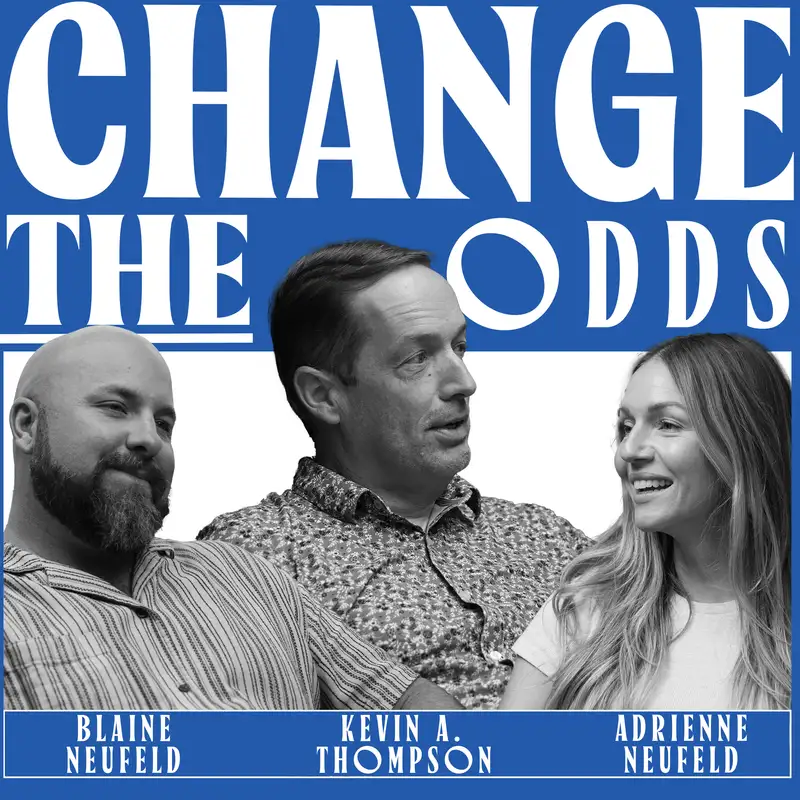
Kevin Thompson [00:00:00]:
Welcome back. Hang on there, guys. Welcome back to the podcast. Change the odds.
Blaine Neufeld [00:00:05]:
Yes.
Kevin Thompson [00:00:05]:
All of the odds.
Blaine Neufeld [00:00:06]:
Okay.
Kevin Thompson [00:00:07]:
Where marriage and family were never meant to be left.
Blaine Neufeld [00:00:10]:
No.
Kevin Thompson [00:00:11]:
To a game of chance. It should be there. It's almost there.
Blaine Neufeld [00:00:14]:
No, it actually shouldn't. I wrote it.
Adrienne Neufeld [00:00:16]:
Well, we're never meant to be a game of chance.
Kevin Thompson [00:00:20]:
We're never meant. Obviously it's not. You know, by now they know.
Blaine Neufeld [00:00:23]:
But at least this time the podcast got the square. Yes.
Kevin Thompson [00:00:26]:
Change the odds.
Blaine Neufeld [00:00:27]:
Change the.
Kevin Thompson [00:00:28]:
This is going to be a fun one. I like this one.
Blaine Neufeld [00:00:30]:
Well, because I.
Kevin Thompson [00:00:31]:
And I think I know all the answers to it. So five spiritual practices every good couple needs.
Blaine Neufeld [00:00:38]:
That's right. So that's what I got. That's what I brought to the table today. You asked. You asked. Yeah. How do we deepen our spiritual connection?
Kevin Thompson [00:00:45]:
Yes.
Blaine Neufeld [00:00:46]:
Right. And I am a pastor.
Kevin Thompson [00:00:47]:
Yes, you are.
Blaine Neufeld [00:00:48]:
So I don't have some of these answers. I'm in trouble. Right. And so. So I just. Yeah, I just kind of brainstormed of if I'm. If. If y' all were to come to me and say, hey, we want to deepen our.
Blaine Neufeld [00:00:59]:
Our spiritual lives together. We have. Individually, what does it look like? Together? I'm like, all right, if I. If I had to be constricted to just five basic concepts, what would they be? And I got them. Okay.
Kevin Thompson [00:01:11]:
I think I got them.
Blaine Neufeld [00:01:12]:
Oh, you already got. You got them.
Kevin Thompson [00:01:13]:
What do you think? And what do you think?
Blaine Neufeld [00:01:14]:
So this isn't even necessary, this show.
Kevin Thompson [00:01:17]:
Find out.
Blaine Neufeld [00:01:17]:
Let's see. Of the five, let's see how many.
Kevin Thompson [00:01:19]:
It's like we're on Family Feud.
Blaine Neufeld [00:01:20]:
Yeah.
Kevin Thompson [00:01:20]:
Number one answer, prayer.
Adrienne Neufeld [00:01:22]:
Ding, ding, ding.
Blaine Neufeld [00:01:23]:
What? No, read it.
Adrienne Neufeld [00:01:25]:
Oh, this is a good start.
Blaine Neufeld [00:01:27]:
People are immediately turning off, like, what kind of show is this? Okay. Prayer will be included in one, but it is not the primary idea.
Kevin Thompson [00:01:37]:
Spiritual leader at a home, reading your.
Blaine Neufeld [00:01:39]:
Bible, reading your Bible included, but not a primary. Going to church included, but not a primary. Fasting included.
Adrienne Neufeld [00:01:52]:
So what are they singing?
Kevin Thompson [00:01:53]:
Worship together at home.
Blaine Neufeld [00:01:56]:
Yeah.
Kevin Thompson [00:01:57]:
Okay, so maybe we only know the fundamentals here, and you're about to bring this.
Blaine Neufeld [00:02:01]:
Well, maybe all those things are good and true. Here's my fear is, with the stereotypical list, if we were just to put into chatgpt and say, give me five spiritual practices, I think what we would get. Well, if we said, what are the five characteristics that will really drive a couple? What you'll get is these lists of spiritual practices which are useful and good and necessary, but those are just one element of something that I think is much bigger and a larger perspective that is necessary to truly bind a couple together. And also, we're all different people. And so, I mean, I learned this in seminary. Look, the spiritual practices that are really meaningful to one person might be less meaningful to another, but yet this other person finds a real connection in this way. For instance, you know, it's not uncommon. You show up on Sunday morning, we are commanded to preach God's word, to sing and worship, to pray, all those things.
Blaine Neufeld [00:02:58]:
Chances are, for the average listener, one of those is more meaningful to them spiritually than the other. Doesn't mean they don't get something from it. But I know this would never be. Y'. All. It. It's conceivable that, man, the worship might mean a little bit more, Kevin, than you preaching.
Kevin Thompson [00:03:13]:
Oh, no, no, no, no, no, no, no.
Blaine Neufeld [00:03:16]:
All right.
Adrienne Neufeld [00:03:16]:
I do love worship.
Kevin Thompson [00:03:17]:
Oh, there it is.
Adrienne Neufeld [00:03:19]:
Whereas not more than preaching, but I love it.
Blaine Neufeld [00:03:21]:
I mean, it's important.
Adrienne Neufeld [00:03:22]:
Yeah.
Blaine Neufeld [00:03:22]:
And so my fear is that we're trying to force a cookie cutter kind of thing onto people instead of having these large guiding principles and then saying, how do you go out and accomplish that?
Kevin Thompson [00:03:35]:
Yeah. So it's interesting. We are. On the other week, my men's group, we were saying, how do you. Where do you experience God? Right. So one guy's like, well, worship, I just love. And one guy was like, when I'm driving and praying, talking out loud to him. And the other was when I'm, like, out evangelizing, I can feel.
Kevin Thompson [00:03:51]:
So everyone was different. But I'm sure there's a fund. Fundamental foundational pieces and fundamental, fundamental, fundamental, foundational.
Adrienne Neufeld [00:03:59]:
Wow. Big words, babe.
Blaine Neufeld [00:04:01]:
See?
Kevin Thompson [00:04:01]:
Big words. And that's why I can't get through this.
Blaine Neufeld [00:04:02]:
Let's. Let's set the context, first of all in a broader picture. Then we'll get down into the Act 5 that are here. And one of it is this. Here's what we're overall looking for, which is in the big picture of things. We want to be united spiritually as we're also united mentally, emotionally, physically, all those things. This is an aspect within friend, partner, and lover. Don't forget, I put this section in the lover section.
Blaine Neufeld [00:04:29]:
Right. Because I do truly believe it is that vulnerable, it's that intimate in what's going on. And. And now, look, there are some people who are listening, and they're like, my spouse doesn't believe I'm a believer. Okay, you know what? Paul in Corinthians gives us a format to go about that. By no means do you divorce the person? Not saying anything like that. What we are saying is, in the ideal scenario, husband and wife are united in a spiritual connection. Now, how do we experience that? That's what we're going to talk about today.
Kevin Thompson [00:04:58]:
I love it. And this is cool for us because I think when we grew up just so context for. For us was both grew up in a Christian home, but we wouldn't have ignited our spiritual maturity until recently. So we can probably see ourselves in some of this. So it's gonna be good. Yeah. Okay, what's number one?
Blaine Neufeld [00:05:14]:
Number one, Here we go.
Kevin Thompson [00:05:15]:
Let's go.
Blaine Neufeld [00:05:16]:
Number one's gonna be a little shocking. Okay. Are you ready for this? Both spouses should be spiritual leaders in the home. It is not just the man's job like that. Both. Well, I think we live in a little bit of a stereotype. What I think is not quite the biblical picture of the idea the man's the spiritual leader of the home, which could imply that the wife has no real leading responsibility. And so if you're in a case where he's not leading and here you are, then it's either you have to usurp his authority, which there's debate of what that would look like, or you have no responsibility and it's just all his fault.
Blaine Neufeld [00:05:58]:
Where instead, I think that both individuals now have a responsibility to be spiritual leaders. And you're trying to now promote and even provoke within each other this growth and this longing. To me, it goes back to even Ephesians 5, where the text begins, submit to one another out of reverence for Christ and this whole idea that God has gifted each of us now with a relationship with him, leadership capabilities, things that we uniquely see, places that we are more comfortable and cognizant of where our spouse isn't. And if both of you now engage in spiritual leadership, then you can become this kind of powerhouse couple. But if it is solely one person's job to lead and the other one's not, then I just don't think the car's firing on all cylinders, even when I don't know what that even means. All cylinders, because I'm not a mechanic. But my understanding is the car isn't running that well.
Kevin Thompson [00:06:56]:
The golf swing isn't in full.
Blaine Neufeld [00:07:01]:
So it's both. I think both need to be spiritual leaders and not just one of them.
Adrienne Neufeld [00:07:06]:
I agree with that. And especially if the wife doesn't have responsibility and let's say her husband is not doing it, you say lead by example, so you kind of have to. If you are hoping for them to get there as well, and then they can come together. Okay, so I had a point, too. Okay, go ahead.
Kevin Thompson [00:07:24]:
I was going to say how contagious it is thinking back of. Of how, like, she was the spiritual leader, without a doubt, she was the devoted one of going to church and doing the things until I started to fall in love with it. And then I grew. And then there's been seasons where I'm like, come on, babe, come with us. And then there's seasons where she's like, what's going on, bud? Like, come on, you know? So it's back and forth.
Adrienne Neufeld [00:07:46]:
I can totally see this team effort.
Blaine Neufeld [00:07:48]:
I think within that, I think when you have a scenario like this, here's something I see on occasion, which is, let's go with that stereotype where the woman is doing a great job leading the husband, really doesn't care about spiritual things, and then he does. And so she's prayed forever for this to happen. Here's a small shift that then is going to have to happen over time, even in her approach and in her brain, is she's gotten so used to being the spiritually mature one and him not being that it's easy to keep on looking at him that way instead of recognizing, oh, wait, he's grown up, he's matured. And so now, what does it look like that I submit to him even as he's submitting to me? The reciprocal nature of that, that begins to happen. Let's take this into a different area. So, right. You get with a couple of, I'm just tired of making all decisions. I just want my husband to make a decision.
Blaine Neufeld [00:08:43]:
So he says, all right, hey, we're going to eat at whatever Jake's or whatever, right? And she's like, I just want you to make a decision. All right, let's go to Jake's. And she goes, I really don't want that. Okay, okay. What do you want? Do you want A, to have a conversation about what this is going to look like? Because in the end, I don't really care where we eat. Or do you want B, for me to make decisions? Because if your greater desire is for me to initiate more, to lead more, to take some off your plate, then whenever I lead the way, I'm going to lead, as long as it's not immoral, then you need to encourage that instead of unknowingly actually squashing the very thing that you desire. And I see this specifically a lot of times, even whenever it comes to spiritual issues, there's decades of praying. I just wish he'd get engaged.
Blaine Neufeld [00:09:30]:
I just wish he'd be involved and that kind of thing. And he finally is. And the moment he shows some initiative or she shows some initiative about what that looks like, well, now there's a little tension, a little fight back to that. Why? Because it's a whole lot easier for me to make my own decisions. It's more fun when I get to do what I want instead of having to negotiate this out with somebody else.
Kevin Thompson [00:09:51]:
So what is going on when you choose lunch and she's not happy with where you're going to go?
Blaine Neufeld [00:09:57]:
Hypothetically.
Kevin Thompson [00:09:58]:
Hypothetically.
Blaine Neufeld [00:09:59]:
Well, I think there just needs to be clarity from the get go, which is what do you really want? Do you want to engage in a conversation so many times. Here's what's happening. Let's go stereotypical. Let's say, hypothetically, the woman says, I just want you to make a decision. What she's actually saying is, I want you to fully engage in this discussion.
Adrienne Neufeld [00:10:17]:
Or I have decision fatigue and I don't have the energy to make it. I just need you to.
Blaine Neufeld [00:10:24]:
But if you have decision fatigue and he says, here's the decision, then you're not gonna fight back on it.
Adrienne Neufeld [00:10:29]:
Oh, yeah.
Blaine Neufeld [00:10:30]:
So that's what teaches you.
Adrienne Neufeld [00:10:31]:
Are you not saying?
Kevin Thompson [00:10:31]:
I guess maybe what I'm realizing is like, you choose where we're gonna eat or what we're gonna eat, and then I will also. I won't actually choose. I'll give you more decisions to make. What about this? No, I don't want that I should just make a decision. It depends.
Blaine Neufeld [00:10:46]:
You just got to clarify what you want. What is it that you actually. What? Tell me what you want. What you really is.
Adrienne Neufeld [00:10:53]:
The real question, it changes from day to day. So even sometimes I don't know what I really want.
Kevin Thompson [00:11:00]:
Yeah, no, I hear so.
Blaine Neufeld [00:11:01]:
I mean, we'll do that often if there's decision fatigue. Okay, I'll narrow it down to three places. That way we're not having to make decisions about what's in and what's out. And then within those three, do you have a preference? I can choose, but would you like to speak into that? That makes it easy.
Kevin Thompson [00:11:16]:
I love it. Okay, that's number one.
Adrienne Neufeld [00:11:18]:
Okay. What is number two?
Kevin Thompson [00:11:20]:
Number two.
Blaine Neufeld [00:11:20]:
Okay, number two, what is it? I think you want to create now a spiritual intimacy within the relationship. So this is. Now, notice this isn't just I'm reading my Bible, I'm doing these kind of things. Those things are important, and we're Going to get to those. But this is to have a perspective of how important of an element this is within our relationship, to not live in denial of this, but instead to prioritize this as an important element. Imagine, and maybe some couples do this. Imagine a couple that never even really considers sex to be a part of their relationship.
Kevin Thompson [00:11:54]:
Crazy.
Blaine Neufeld [00:11:54]:
That's ridiculous, right? I mean, this is part of God's design. And yet there are some couples who never really even consider the idea of spiritual intimacy. They don't even know what it looks like. How do they experience it in any way? And so how can we begin to create this in a way that there's just an ongoing conversation about spiritual things where we're not making major decisions without thinking about what does God want for us, what does he want from us? And to making this a normal element within our lives. In much the same way that obviously friendship is going to be so important. We're going to hang out together. If we're never hanging out, something is wrong. Obviously, we got to learn how to handle money.
Blaine Neufeld [00:12:40]:
We got to parent the kids. This is just another element within our relationship. And yet here's what I see. For many couples who are listening right now, this is a place that really isn't ever discussed. One of them or both of them is so insecure about the topic, and maybe they didn't grow up in church, or maybe they feel like their faith is weak, or they struggle to read the Bible and say they don't know what to do. And they feel like they don't have the ability to stay in it for a real conversation. And so instead of growing, they just deny it, don't talk about it in any way. And I think there's a danger within that.
Blaine Neufeld [00:13:19]:
And I think you're really robbing yourself and your spouse of one of the most beautiful, intimate aspects of a relationship whenever you never prioritize a spiritual intimacy.
Adrienne Neufeld [00:13:29]:
I think the depth that comes into a marriage when you have spiritual intimacy is like. Is like nothing else. But it is hard and can be kind of awkward. You know, I mean, we kind of struggle with this to pray. We talk about God and stuff all the time. But praying together is not like a natural thing for us. And for some people, even just talking about it is awkward. So how do you move past the awkwardness if you're not used to that?
Kevin Thompson [00:13:54]:
Yeah, can I maybe answer? Maybe try to answer through experience. Hey, sit back and relax. Just. Just. Because I'm like, I'm. I'm analyzing our ongoing maturity. So I would just be so uncomfortable to pray in front of everybody when you know, this is 10 years ago or whatever. And you know, other guys are in our group, they're pastors.
Kevin Thompson [00:14:15]:
Oh my gosh, they know how to pray. And I just started praying. I just started doing it. I started doing it on my own, started actually driving in my car and praying out loud and started to build that muscle. Up to then I gained a little bit of confidence of like, oh, this is just a conversation with me and my father. Okay, I get that. And then I just started to do it in front of other guys. This is, this is my ongoing journey.
Kevin Thompson [00:14:37]:
Although we aren't there together that often, it's getting more comfortable praying. It's interesting. By just simply starting to do it and strengthen the muscle, I've gained more confidence. And then the, the individual practicing that I've done in my own faith has given me confidence to talk more about Jesus. And so now it's becoming just part of our family culture to talk about it. We happen to now work in ministry. I think that's obviously an easy byproduct, but I think if we had this maturity and I was in the business world and I was seeing kingdom minded things and doing this, this is just part of my vocabulary. Therefore it becomes more comfortable.
Kevin Thompson [00:15:16]:
So this idea that it starts within. Within. Right. And it keeps practicing, keep practicing. And then this awkward vulnerability is interesting because in our guys group, someone said to me, oh my gosh, Blaine, you're such a good prayer prayer guy or whatever. I'm like, hold on, I'm no good with words. But I just recognize the flashback of like, well, it took years of attempting it and being vulnerable. You should try today and start the journey.
Kevin Thompson [00:15:44]:
And the guy starts to pray. And it's very encouraging because that's the first step.
Blaine Neufeld [00:15:48]:
Yeah. So no, I think, I think that's great. And I think that's a great example of how you grow into it. And what does that actually look like? I think, Adrienne, I mean, for me it's things like, what is the space in which you feel most comfortable to have meaningful conversations? So oftentimes for me and Jenny, it's on a walk on vacation. So generally it would be side by side, not face to face. It would be side by side. And it would be then in some kind of break away from the normal demands of life, whether that be on a daily concept, on a walk, or on vacation in the car, something like that. And then to begin to ask questions like, hey, what do you see God doing in your life right now? What do you think God's purpose is for us? Why do you think God would allow us to go through an experience like we've gone through and to make it? Why do you think God has us together to begin to just explore those and to recognize, look, there's no judgment here.
Blaine Neufeld [00:16:50]:
There's not going to be any right or wrong. Just share from your heart what you're feeling about these types of things. Then it becomes depending on where a couple is and what their personality types are, for some couples, it really is getting to a Bible study together to where now you're having the shared experience. I think a powerful thing would be. Obviously, it's unique in our family because they're listening to me, but I think it's a normal thing of. In the car ride home, hey, kids, what did y' all learn in class today? And as they say, whatever biblical truth they learned, is there a way. Hey, how do you think that applies to our whole family? So let's throw a whole conversation for the family to where we're used to talking about these things. And then you can say, well, Mommy and Daddy, today, Pastor Mark, here's what he talked about.
Blaine Neufeld [00:17:37]:
And then you're talking with each other as they're hearing it, you're talking to each other. And you might ask questions of, hey, what stuck out to you the most today? What was the part that you didn't understand? What was the part that was most interesting? That kind of thing. What. What from this text today causes you to love Jesus more? Now you're just beginning to normalize this conversation that's happening. And then you can grow toward the next thing, you know, it just becomes a very normal thing. As you're cleaning the kitchen and you're talking about maybe moving to California, it's not this random thing of, ooh, do I bring up God? Do I not bring up God? It's just this very natural, hey, what's your mom gonna think? What does God think? It's just this part of the conversation.
Kevin Thompson [00:18:21]:
Yeah, we're going off topic here a little bit, but it's interesting when our kid, one of our kids will. He loves it here, but he loves Canada. He loves this. He's in the mix. Right. And it's just like, why did you bring us down here, dad? Right. Kind of in frustration. And my answer right now is, because we felt like mom and dad felt like God had us on a journey that comes through here.
Kevin Thompson [00:18:44]:
We might go back, we might have to do this, we might have to do that. I don't know. But I'm trying to make it okay. I don't want to blame God in his eyes, you know, I don't want to pass the blame. It's just like, we feel confident that this is where we're supposed to be. I'll take ownership of that. But at the same time, you know what I'm saying?
Blaine Neufeld [00:19:01]:
Oh, no, absolutely. So. So I think. I think that it's so wise, especially if you have a child who is experiencing some negative consequences of this move, which they are. They are. I know whenever we moved here, one of the things I hated the absolute most and people are so well intended. But whether we were here or whenever we went back home for the holidays and back to Arkansas on the holidays, people would ask, hey, so, Ellis Islas, which one do you like better? California?
Adrienne Neufeld [00:19:27]:
Arkansas?
Blaine Neufeld [00:19:28]:
Well, how are they supposed to answer that? Like, that is. And I totally get people just aren't thinking and they're trying to engage in conversation, but you're literally asking them right there to say, so are you happy that you broke Grandma's heart, or do you hate your parents for moving you to California?
Adrienne Neufeld [00:19:45]:
For real?
Blaine Neufeld [00:19:46]:
How are they supposed to answer that question? Right, right. So I think it's so wise with a child here who's vulnerable. Do not put the blame on God. Look, well, God moved us here. It's just showing no responsibility. No, you know what? God gave the two of you choices. A choice was before you. You believe that God.
Blaine Neufeld [00:20:03]:
You can glorify God in the midst of this move, and you are choosing to do so. It's the same equivalent of when somebody says, God told me to break up with him. No, take responsibility. Own this for yourself. Don't put this on somebody else. So I think it's a very wise concept and approach of how to go about that. But just to begin to have these conversations, obviously these first two points of each person, be a spiritual leader and create spiritual intimacy within your home now implies you are both taking full responsibility for your own spiritual lives. And I am going to be fully engaged with God in my own personal Bible study and prayer and service.
Blaine Neufeld [00:20:41]:
The transformation of my own heart, the spirit working within me, all of that is mine. And if there's any listener that's out there thinking themselves, I could be such a better spiritual person if my spouse would do blank. That is in no way biblical. You are fully responsible for your relationship before God, nobody else. Now, can that other person then begin to enrich your life in a fuller way? Absolutely. But if it's not where you are, it's not where you are. Do not use that as an excuse to in any way have some kind of sin. A second rate spiritual life, and that's a prerequisite for both of these.
Kevin Thompson [00:21:18]:
And, and it frees you up from the burden of feeling you have to fix that person or you know, encourage that person. I gotta help save that person. No, no, no. Just be a good byproduct of the Holy Spirit and Jesus and all the things around him or her until. And now I'm thinking about friends, I'm thinking about other people, fam, whatever. It's like this idea that I want you to know Jesus so bad that I have this burden. I gotta let it go. Show them and show them.
Kevin Thompson [00:21:42]:
Yeah.
Blaine Neufeld [00:21:42]:
I mean you don't use your words, you do, but let's show them.
Kevin Thompson [00:21:46]:
Good.
Adrienne Neufeld [00:21:46]:
All right, so number three now.
Blaine Neufeld [00:21:48]:
Okay, now we're getting to Yalls answers. All right, so what tends to be the end all, be all list to me is just one point and that is this, that you need to build spiritual rhythms into your family which is going to include your own life too. And so this is where prayer comes in. This is where serving and fasting and all these rhythms about our spiritual lives come in. Ultimately I think in one big swoop is we as a family need to find a local church and fully engage. It doesn't need to run our lives by any means, but we're going to find a church that works. So we're going to submit to some spiritual leadership which means there's going to be a plan of how they're going about trying to fulfill the Great Commission and the Great Commandment. And as long as we don't have a moral obligation, moral objection to that, we're going to submit to that.
Blaine Neufeld [00:22:39]:
So we're going to show up on weekends and we're going to listen to sermons we didn't pick. We're going to pray prayers that we didn't pick. We're going to sing songs that we didn't pick. All of that we're going to trust the Holy Spirit is using to change us. We're going to find our place of service within all of that. We're not going to by any means just become so engrossed in the church that it's hindering our family time together. But they are. Our kids are going to see mom and dad serving.
Blaine Neufeld [00:23:03]:
We're going to. I have a controversial take on this compared to where we are, but for me I think as old as your kid, as soon as your kids are old enough to endure a Sunday service as a family. They are in service with us.
Kevin Thompson [00:23:16]:
Oh, really?
Blaine Neufeld [00:23:17]:
And then they're going to go to their hour, their time. So I love the whole idea. What we had back in Arkansas was you worship one, you serve one, and. And so basically, as a family, you pick a service, and as soon as they're old enough, they're in with us, and they're gonna be between mom and dad. Watching mom and dad worship, recognizing what's going. They're not gonna catch everything that's taking place. And I get it. Maybe there's a sermon that's about an intimate topic that we're gonna pull them out that weekend.
Blaine Neufeld [00:23:43]:
But I do not like the idea of splitting a family for a weekend. And they never have the shared time together. Now, some of my coworkers disagree. That's totally fine that they're wrong. I still fully respect them. But then I do think it's important that they have their own time as well. And so let's say for Jenny and I, let's say our time of service is some other time. So what would it look like that we worship together as a family, and then the kids go for an hour into kids ministry, and she and I have coffee or connect in some way.
Blaine Neufeld [00:24:17]:
It does mean to fully plug in as a church.
Kevin Thompson [00:24:20]:
I'm thinking out loud here now, but, like, with our group of friends, we're kind of getting into a season where, like, a family Bible study, like, I know kids can make it crazy, but. And it's got to be critiqued in a way where it's like, that would be kind of fun. You know, when we hang out on a Tuesday night or Wednesday night or whatever, it's like, no 30 minutes. We're going to read the scripture, we're going to talk about it. Kids just stay quiet, ask some questions, Whatever you want to do. I think that'd be kind of cool.
Blaine Neufeld [00:24:45]:
Five minutes, not 30. Yeah.
Adrienne Neufeld [00:24:48]:
I was going to say 30 is a long time.
Blaine Neufeld [00:24:49]:
Seriously, with the age of your youngest.
Kevin Thompson [00:24:51]:
True.
Blaine Neufeld [00:24:52]:
What would it look like to start getting these small wins? And so here's why I do think sometimes family devotionals can go wrong, is there's this expectation in our head of what it has to be. And then we try it and we can't manage it. And then we think we're failures, when in reality, we're actually putting expectations upon them that probably aren't. Aren't that doable. So what would it look like if, at the age of where especially your youngest is. If we just try These very short wins and then begin to expand it. And maybe it even is an idea of, hey, together we're going to do this. Now with the older kids, we're going to start experimenting with a little bit of one on one where they have now more time as well.
Blaine Neufeld [00:25:36]:
As the youngest one grows up, she's going to experience that as well. I think those can be powerful moments. And then, then you want to, I mean, you want to celebrate the big wins in life, like even the transition of as they go up a stage in Sunday school. Okay, well, what does this mean? I remember one of the things I missed the most about Arkansas is when our kids went into first grade, we would give them a Bible, right? And so we would call them up on that Sunday and I would literally kneel down on stage, I bring them to me, they'd say their name, I'd, you know, we'd toy with them for a little bit. I'd hand them a Bible, they move on. And literally this thing took forever. It took 20 minutes in the service. But we were small enough, we could do that.
Blaine Neufeld [00:26:20]:
You couldn't do that here. We were small enough, you could do that.
Kevin Thompson [00:26:22]:
That's what we did too.
Blaine Neufeld [00:26:23]:
But it was so memorable. And it is this idea of, hey, you're transitioning now into there's more responsibility that you have to have. How do we celebrate that in the midst of a family? How do we celebrate a baptism? How do we celebrate and not rush a spiritual pressure upon these kids to where we get our theology confused and thinking, oh, we got to get them baptized because that'll make their eternity better. We got them baptized and the next thing you know, we're baptizing them in kindergarten when they have no awareness of what's going on. Instead of, take your time, wait, allow them a few years after they come to Christ before they get baptized to.
Kevin Thompson [00:27:00]:
Make sure it's a meaningful experience for them.
Adrienne Neufeld [00:27:02]:
Do you have thoughts on child dedication?
Blaine Neufeld [00:27:05]:
I mean, I love the idea of child dedication. And so from our theological vantage point, obviously there's a good number of denominations that I have a deep respect for that do infant baptism. They have a different view of baptism than what I have, but I totally get it and I respect it. I just have a different view. But I love the idea of what does that look like as a family committing that we're gonna raise these kids totally in this climate. So as a community, basically in non denominational and Baptist world, we invented child dedication because we don't do infant baptism. Yeah, because. But we still like the purpose behind it.
Adrienne Neufeld [00:27:41]:
Yeah. 1. Our youngest is not dedicated, but our other two are. They'll be fine, right? We're working at a church.
Kevin Thompson [00:27:50]:
It's fun to, like, have those conversations with our oldest because he's been wanting to. He loves church. He's all around it, and he wants to get baptized. Okay, explain to me, why do you. And it's like this intellectual conversation that we get to have. Oh, he gets a big, big piece of it, but he doesn't quite get it right. And so it's like, okay, let's go back.
Blaine Neufeld [00:28:08]:
And, you know, over what age?
Kevin Thompson [00:28:11]:
Nine, four.
Blaine Neufeld [00:28:13]:
Fourth grade.
Kevin Thompson [00:28:13]:
Yeah.
Blaine Neufeld [00:28:14]:
Yeah. These are. This is perfect time.
Kevin Thompson [00:28:16]:
Fun time.
Blaine Neufeld [00:28:16]:
So here. Here's so obviously preacher's home, right? Ella was afraid of drowning, and she knew who was going to baptize her, and so she waited a little bit longer. Silas early on, wanted it, wanted it quickly. I'm like, no, now you're not old enough. You got to wait. It doesn't mean you're not a believer. You clearly are. And so, like, in third grade, we're driving down the road one day, and he's like, when can I get.
Blaine Neufeld [00:28:39]:
Like, I'm sick of this, dad. When can I get baptized? You're holding me back. And I was like, well, why do you want to get baptized? And he laid out the gospel in, like, this perfect explanation. And I'm like, well, that's good. Okay. Okay. It's probably about time for this to happen, but here's why I like to wait until then. Again, baptism doesn't save us.
Blaine Neufeld [00:29:01]:
Parents sometimes can rush that thinking, oh, if anything happens now, we're safe. It doesn't work that way. Here's why I like to wait until at least third, fourth, fifth grade. Have y' all ever noticed that a lot of Disney movies include death? Right. Why is that? Because Disney movies are primarily targeted at kids around third, fourth, fifth grade. And that is the age in which you can start becoming truly aware of what death means, that it's final, that grandma's not coming back younger than that. It's kind of out of sight, out of mind, and we still think that the person can be there. Whatever.
Blaine Neufeld [00:29:37]:
That's the age where you're dealing with your own mortality for the first time. It's not uncommon for kids that third, fourth, fifth grade to start having nightmares, to start having dreams about mom or dad dying in some way. Why? Their brain is growing in an awareness of what this means. So there's a reason that I think we start to baptize around that Age is they're starting to be aware of what eternity can even be.
Adrienne Neufeld [00:30:00]:
For sure.
Blaine Neufeld [00:30:01]:
True.
Kevin Thompson [00:30:01]:
I love that. Okay, so spiritual rhythms, that's gonna include also the idea of serving tithing treasures, talents, generosity, all the spiritual disciplines. Yes.
Blaine Neufeld [00:30:11]:
Even bring. Bring kids in on that. Look, here's what mom and dad, here's why we give and here's what that looks like. And oh, if you get an allowance, you work on something, you get that kind of thing. I mean, I got a 17 year old, right? And so we got the car and we got gas, we got insurance, we got all those things. And I mean, one thing Jenny and I were talking with him about is, look, a part of this job now is we're family of generosity. And so that means that you're working, that you tithe. What does that look like? Like, and then how.
Blaine Neufeld [00:30:42]:
If. If you're living in these ways, here are some things that we can take care of. If you choose not to live in these ways, here's some things you can take care of on your own. So there's some opportunities there to begin to train that early.
Kevin Thompson [00:30:52]:
Train it for sure. And it's interesting to me when I start to see, I've been going deep diving on like the idea of my. A poverty mindset of seeing this world or a generous mindset and knowing that there's an abundance to see traits of those things in children, not necessarily our own, but others. There's some that have this spirit of generosity and you can just tell, like they have this faith in this. And then there's others that are doing the math and trying to figure out. But it's like such a vulnerable stage where you can say those doing the math things, those are great attributes. But let's not hold on and learn how to let go.
Blaine Neufeld [00:31:27]:
Yeah. And do not put too much pressure on your kids because different personalities are going to be different, have different things. Right. Jenny and I have had this ongoing conversation when our kids were little. She's like, they're just so ungrateful. Ella, if you're listening right now, my apologies. We know Silas isn't listening, but they're just so ungrateful. I'm like, yeah, they're six.
Kevin Thompson [00:31:48]:
Right?
Blaine Neufeld [00:31:49]:
Like gratitude. Yes. We have to instill these things, no doubt. But the goal is that they're grateful at 30, they're generous at 30, they're faithful at 30. We can't expect them right now to fully understand everything that's going on or even to have these kind of things. Their brains are still forming. And so Even the idea of when a two year old learns the word no, that's a very important step because they are now learning that they have some agency over themselves. And so as a parent hates to hear that word, it's developmentally brilliant.
Blaine Neufeld [00:32:21]:
Well, if you get confused about that, you can be like, well, see how spiritually rebellious they are. No, no, no, no. They're just growing up and so don't feel this pressure. If you have one that is quickly generous and the other one isn't, could be just different personality types and there's strengths that's there. How can we bring that out?
Kevin Thompson [00:32:38]:
That's it. Yeah, that's exactly. Okay, that's three. I think we covered that.
Blaine Neufeld [00:32:42]:
All right, four. So each person, be a spiritual leader. Create spiritual intimacy. Build these rhythms within your life. And this is number four is so often overlooked. Apply God's commands first at home. So even as you. Even this should even change how you begin to read the Bible, that anytime the Bible gives us a command, Jesus gives us a command of some sort.
Blaine Neufeld [00:33:06]:
See that your first task of applying that is actually at your house. And then it's going to ripple into all these other places. So even this idea of love your neighbor, right? Okay, first and foremost, love each other. Your immediate neighbor is literally the one in bed with you. What does that look like? Then how to love this person and then to love our kids. And then how can we as a family love our literal neighbors who live beside us, then love our neighbors that we do life with. We're teaching our kids what this looks like. And then it ripples out into the stranger we see at the gas station, or however that looks like.
Blaine Neufeld [00:33:44]:
But to first apply God's commands in the house, so read the Sermon on the Mount. Right? So my book happily takes the Beatitudes, applies them to marriage, and it's literally me saying, all right, the words of Jesus in my life apply first and foremost to Jenny. She's the one that I have to exhibit these two first. And then why? Because she loves me more than anybody else. When I get it wrong, she can tell me the truth. And yet I still know that I'm loved. I can make mistakes and still understand it. And then as it goes out from beyond that.
Blaine Neufeld [00:34:17]:
But here's what tends to happen is it tends to be the home is where we apply it last. Well, that's going to erode our spiritual intimacy. We're not going to be spiritually connected. If these commands of Scripture are hypothetical in this home and reality outside of it.
Kevin Thompson [00:34:34]:
Yeah. To validate that point, remember when I said, let's do a family Bible study? We don't necessarily always do devotions. Just our family. I should start with just our family, like the little ones after dinner. And, you know, it's just like, I'm so anxious to go and help everyone else that I've bypassed this idea of, you know, help your family first.
Blaine Neufeld [00:34:55]:
Right.
Kevin Thompson [00:34:55]:
Like, we. We've started and we've moved in and out of this season, but we started a prayer box, a family prayer box. We thought that was a really neat idea to, like, start to introduce prayer to our kids and. And people would come over and they would be like, we'd bring them included in them. And that was fun for the kids because they were proud of prayer and praying together. But the way we were praying was, like, different than maybe you would see on a, you know, close your eyes. It was a family conversation. And yes, Lord Jesus, thank you, Lord Jesus.
Kevin Thompson [00:35:24]:
But that was a fun practice.
Blaine Neufeld [00:35:25]:
I'm starting to remember now, even as you're listening on. On a weekend, is that whatever the text is, to think about it first and foremost. So Sunday's text this past weekend, it ended Ephesians 5, maybe 32, be kind and compassionate, forgiving one another, just as God in Christ Jesus forgave you. Okay. Be kind and compassionate with Jenny, with Ella and Silas, forgiving them just as Christ forgave you. So my first place to apply that now is that there and then all the other. I'm not denying that you need to apply in other places. Clearly you do.
Blaine Neufeld [00:36:04]:
But even just to have that perspective. And so for us, this is where generosity comes in. This is the whole idea of, okay, all these commands, the idea of telling the truth, of not having falsehood, of being humble, of being honest, of working hard, of serving. Right. I mean, even you could even take Sunday's text of steal no longer. Instead, you should work. Right. Well, are you working in the home or not? Just sitting back, stealing the labor of everybody else.
Kevin Thompson [00:36:34]:
Great point.
Blaine Neufeld [00:36:34]:
As soon as the kids are old enough, what are their responsibilities? How do they contribute to the wholeness of what's going on?
Kevin Thompson [00:36:41]:
So this could be where you imply your family values. A lot of it would come into this area, right?
Blaine Neufeld [00:36:48]:
I think so. And the idea of family is a place that is a climate in which God uses it for our own transformation. It both supports us and challenges us. There's nowhere you're going to see your sinfulness more than in your own family, in your marriage, in your parenting. It's going to reveal your desperate need for Jesus. And so if grace doesn't permeate everything, every aspect about what's going on, and I think that's an important aspect of. Let's make sure that we're applying God's commands and realities first at home. But what that means in a true picture of the whole truth of Scripture, means this is going to be a place to find by grace.
Kevin Thompson [00:37:27]:
Yeah.
Blaine Neufeld [00:37:28]:
Too many Christian homes are a legalistic, demanding, exhaustive standard that you can never live up to. And God's ashamed of you, and so am I. Well, that's not truth and love. That's not even truth. It's partial truth. What does it look like for this to be a place that is permeated by grace even as we experience the consequences of poor choices and things like that?
Kevin Thompson [00:37:52]:
Love it. That is good. I got lots to think about there. Five.
Blaine Neufeld [00:37:56]:
All right, number five, final one. We're running out of time, so we gotta do this quickly. But the final one is this. Seek God's purposes for your marriage. And notice I say purposes, not purpose, not like there's just one thing, just only one thing we gotta accomplish. It's not that. It's that literally, God has plans for y'. All.
Blaine Neufeld [00:38:16]:
He's Southern, so let's say this in the most Southern way. God has plans for y'. All. Go find them. Go be a part of them. Recognize that God truly has created in advance good works for us to care about. There's a reason he has allowed us in his divine sovereignty to come together. We have chosen.
Blaine Neufeld [00:38:35]:
No doubt we are responsible for the choices that we make. But let's face it, if God did not want us together, a lot of anything could have happened to keep us apart very easily. He has allowed us to come together. Now we come with different strengths and weaknesses all mixed together. He's placed us in a very specific geographical location in a very specific generational time. And he wants us to now make much of him. What do you want from us? And notice how this gives your marriage such a higher purpose, big time. And a higher calling.
Blaine Neufeld [00:39:04]:
You've heard me say before, one of our family values is family is bigger than us. It's not just about us. It's about how God wants to bless us now, to be a blessing to everybody else. And whenever you lift your eyes up together as a couple and as a family, to a much larger purpose than just your own hormonal desires or just the practicality of life, it gives you a lens through which you view all the smaller hardships of what's going on and to recognize even God can use this to make us know him better and to make him known in other people.
Adrienne Neufeld [00:39:39]:
What do you think are some ways couples can discover and live out God's mission for their marriage? You know, whether it's in church or family life, community.
Blaine Neufeld [00:39:49]:
Yeah. I think you can look at what's our unique skill set, what's our passion? Look, there's a million needs out there. Why do some interest you more than others? It doesn't mean the others aren't important. Clearly. Clearly they're important. But you're drawn specifically to some places. All right, Pay attention to those and then go after them. Here's one of the hardest things as a pastor is you want people passionate about the ministries that they're doing.
Blaine Neufeld [00:40:17]:
But some people believe that their ministry is the only one that matters. And so they'll come to you and they'll be like, hey, you're not giving enough attention to this. You're not announcing this enough. There's nothing we do that's more important than that. No, that's not true. That is as important as everything else we're doing. So it doesn't mean that this becomes the end all, be all, but it does mean God has given you a passion for this. Why? Why is God giving you all passion for couples? All right, well, chances are.
Blaine Neufeld [00:40:44]:
Does that align scripturally with what he's passionate about? Is there a problem in the world that can be solved if that begin to be worked upon? And are you uniquely positioned to make a difference in that? Absolutely. Like, all those circles would work together and to where y' all working with married couples would be right in the center of those different circles. And so, all right, there it is. But here's the thing. Not everybody listening needs to do that.
Kevin Thompson [00:41:06]:
Right.
Blaine Neufeld [00:41:07]:
Doesn't mean that marriage isn't important. Clearly, marriage is important. But maybe their passion is in missions, or maybe their passion is, man, we want to see kids come to know Jesus better. We want to help the homeless. We want to feed the poor. All. All those things are great, and we all have to have some involvement in those. But where is your attention going to primarily go? And so how has he gifted you what's a unique part of your story? If you've overcome something, if he has led you through a very difficult time and season and now you're on the other side, chances are God can actually have some redemption of that pain as you help somebody else through.
Blaine Neufeld [00:41:46]:
And so even as you're walking through an experience to recognize a day is going to come in, which God's actually going to use what he's doing for me. This is Paul in Corinthians, that as God comforts us, we then can comfort other people. So, I mean, I literally was responding to a text message before we started recording right now. Somebody had a baby that has down syndrome. Can't wait to talk to them. Can't wait. Now I got to be careful because they are brand new, and I can come running in with my 20 years of experience. Oh, my goodness.
Blaine Neufeld [00:42:19]:
Do you know that your child's gonna be able to go to college and what that can. Look. Let me show you pictures of Ella. And that's overwhelming to them for sure. But if I can be patient and think about them, I can meet them right where they are. And I remember what it was like. I know what it was like in the goodness of God, in the midst of it all. And so look at your story, in part.
Blaine Neufeld [00:42:36]:
So what are you passionate about? What are you gifted for? What are the problems of the world that you could help solve? What's the unique aspects of your own story that God has used? And then just start doing stuff. Don't wait. Don't wait for the perfect position, the perfect thing. No, no. Engage in service in some way, and then you'll navigate and wiggle to the very place that God's going to best you to.
Kevin Thompson [00:42:57]:
That's good.
Adrienne Neufeld [00:42:57]:
That's wisdom.
Kevin Thompson [00:42:58]:
I love it, Kev. I love how you started with individual. You went to couple. You went to family, God's commandments, and then this whole purpose piece. You know that we're super passionate about this, and we want people to experience and find out their superpower, couple mentality and just. But it all starts with just our intimacy with God individually, and it grows.
Blaine Neufeld [00:43:18]:
And part of this goes back to a previous episode where the two of y' all were highlighted on this idea of y' all went away and had a dreaming retreat.
Kevin Thompson [00:43:25]:
Yes.
Blaine Neufeld [00:43:26]:
Make your spiritual life an aspect of those dreams.
Kevin Thompson [00:43:29]:
Yes.
Blaine Neufeld [00:43:29]:
And then come back and tap into the reality of what that is.
Kevin Thompson [00:43:32]:
I love it.
Blaine Neufeld [00:43:32]:
And you know what happens if they do that? What will it do, babe?
Adrienne Neufeld [00:43:35]:
Change the odds.
Blaine Neufeld [00:43:38]:
We'll see you next time.