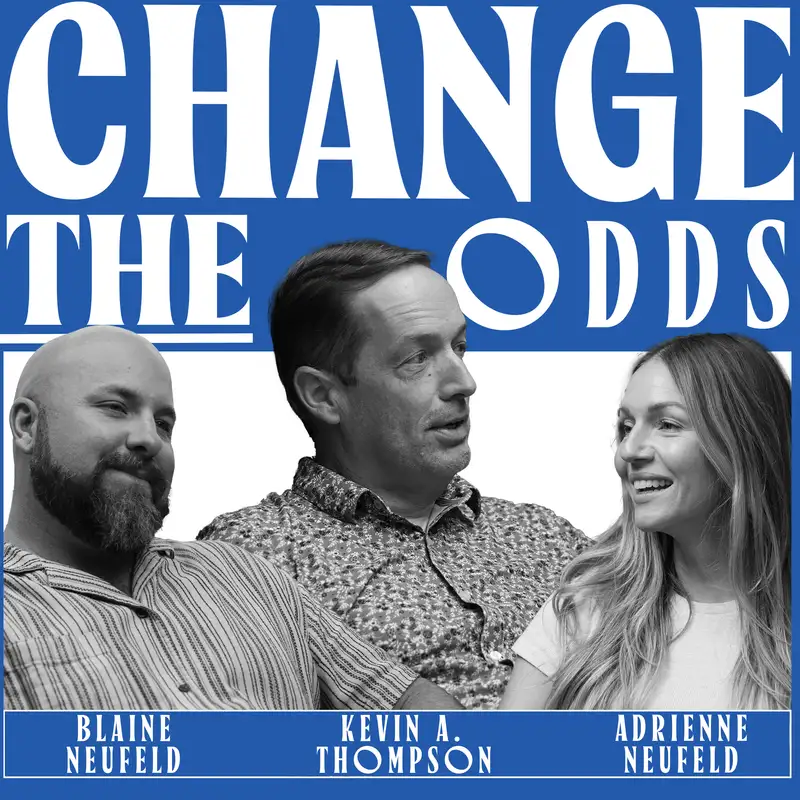
Blaine Neufeld [00:00:00]:
Welcome back to Change the Odds podcast. Here we are with Jason and Stephanie Caine. No Kevin today, thank goodness. Right?
Jason Caine [00:00:07]:
I mean, thank goodness.
Adrienne Neufeld [00:00:08]:
But I'm here.
Jason Caine [00:00:08]:
I was.
Blaine Neufeld [00:00:08]:
Oh, and my wife Adrienne is also here. Tough morning for us guys.
Jason Caine [00:00:13]:
Is it? Why is that?
Blaine Neufeld [00:00:14]:
There's a lot going on in our household right now.
Jason Caine [00:00:16]:
What? Small children. Be specific.
Adrienne Neufeld [00:00:19]:
Children. Family in town. Which is great.
Blaine Neufeld [00:00:21]:
It's great.
Stephanie Caine [00:00:21]:
Yeah.
Blaine Neufeld [00:00:22]:
Great.
Jason Caine [00:00:22]:
Who's in town?
Adrienne Neufeld [00:00:23]:
My sister.
Jason Caine [00:00:24]:
Okay. Yeah.
Adrienne Neufeld [00:00:25]:
And her one year old.
Stephanie Caine [00:00:26]:
Yeah.
Blaine Neufeld [00:00:27]:
And I got the time wrong. Okay. On this. Told her nine. I rushed her out of the door.
Adrienne Neufeld [00:00:31]:
So then I came with wet hair.
Jason Caine [00:00:34]:
I think she was on a text thread where we said 9:15.
Blaine Neufeld [00:00:36]:
I thought so, too.
Jason Caine [00:00:37]:
Yeah.
Adrienne Neufeld [00:00:38]:
It's okay.
Blaine Neufeld [00:00:39]:
Yeah.
Adrienne Neufeld [00:00:40]:
Here we are.
Blaine Neufeld [00:00:40]:
Anyway. Here we are. Jason Caine, one of America's greatest preachers. That's the line that I have under his extreme. And Stephanie Caine, one of the greatest counselors. Don't always get it.
Adrienne Neufeld [00:00:54]:
Doctorate in counseling, doctor in counseling.
Blaine Neufeld [00:00:56]:
And she is helping people. I try to tell us a little bit about what you do. We all know that, Jason.
Stephanie Caine [00:01:02]:
Yeah, well, I'm a therapist. Yeah, I'm a counselor. So I meet with mainly adults, couples, some teens now, and just help them through different things, whatever happened, whatever they're dealing with in life, whatever they're struggling with.
Jason Caine [00:01:18]:
Yeah.
Stephanie Caine [00:01:20]:
That's what I do.
Blaine Neufeld [00:01:21]:
And you help Jason get through the day.
Jason Caine [00:01:23]:
Praise God.
Blaine Neufeld [00:01:24]:
Right?
Adrienne Neufeld [00:01:24]:
That was actually one of my questions. Like, do you counsel him on the daily.
Stephanie Caine [00:01:28]:
No. First of all, Jason is also a counselor. Actually, he has a master's degree in counseling as well.
Jason Caine [00:01:35]:
Best kept secrets.
Adrienne Neufeld [00:01:36]:
I would have never known.
Jason Caine [00:01:37]:
That's why I'm so compassionate.
Stephanie Caine [00:01:38]:
Counselors here. That's why you're so confession.
Blaine Neufeld [00:01:41]:
That's shocking since the advice that he's given me over the years.
Jason Caine [00:01:45]:
Bad advice. Let's talk about that. Bad advice. What bad advice?
Blaine Neufeld [00:01:48]:
No, he's great. He's got great advice.
Jason Caine [00:01:50]:
Thank you. Yeah. I would say Stephanie doesn't counsel me, but she does give me. She offers, like, advice on dealing with situations with other people, but she's not looking at me like a shrink and trying to figure me out. Example, if I'm dealing with a conflict at work or if I'm going to talk to a co worker, she'll help me shape the conversation so that I don't crush the person. Yeah.
Blaine Neufeld [00:02:12]:
And you're sitting at home watering your plants. You got lots of plants.
Stephanie Caine [00:02:16]:
Lots of plants.
Adrienne Neufeld [00:02:17]:
Big plant girl.
Jason Caine [00:02:18]:
Hundreds of plants.
Blaine Neufeld [00:02:19]:
How many plants, Jason?
Jason Caine [00:02:20]:
There's 144 downstairs.
Adrienne Neufeld [00:02:22]:
No.
Stephanie Caine [00:02:23]:
Yeah, yeah.
Jason Caine [00:02:24]:
Just down.
Stephanie Caine [00:02:27]:
Okay. It started in 2020 when we were. What do they. What did they call it?
Jason Caine [00:02:32]:
Quarantined.
Stephanie Caine [00:02:33]:
Quarantined. And I was like, I'm fine without people. Like, I'm. I'm doing okay with just my family. And then all of a sudden, all these plants started coming in, and I'm like, other people are being so impacted.
Jason Caine [00:02:45]:
Let's be clear. She was fine without people before then.
Stephanie Caine [00:02:47]:
I think I was replacing even more people, though. And then I realized plants are actually better long term than people.
Blaine Neufeld [00:02:55]:
People.
Stephanie Caine [00:02:55]:
People is more of a, you know, struggle. Consider their feelings and stuff. Plants, you water them.
Adrienne Neufeld [00:03:01]:
Do you talk to them?
Stephanie Caine [00:03:03]:
I talk to them a little bit.
Blaine Neufeld [00:03:04]:
Yeah.
Stephanie Caine [00:03:04]:
Yeah, I talked to them a little bit. I named them. Yeah.
Adrienne Neufeld [00:03:07]:
Girl. Baby girl.
Stephanie Caine [00:03:09]:
You got this.
Blaine Neufeld [00:03:09]:
How many of the 140 are bought? How many are given to you? Are people now knowing that you're a person?
Stephanie Caine [00:03:15]:
That's the cool thing. Yeah. Like, once you're known as the plant lady, it's like, I'm an easy people.
Jason Caine [00:03:19]:
Support your addiction getter.
Stephanie Caine [00:03:21]:
Yeah.
Jason Caine [00:03:21]:
Yeah.
Stephanie Caine [00:03:21]:
Hey, but you're enabling me.
Jason Caine [00:03:23]:
I am breathing cleaner.
Stephanie Caine [00:03:24]:
Yeah.
Blaine Neufeld [00:03:25]:
Similar to. Jason is not a gift person. So people don't get Jason gifts. We've been very clear about.
Stephanie Caine [00:03:30]:
They should not.
Blaine Neufeld [00:03:32]:
You might be one of the worst
Jason Caine [00:03:33]:
gift receivers in the world. In the world. Yeah. Yeah.
Adrienne Neufeld [00:03:36]:
We need to dive into that a little bit because I'm kind of a bad gift receiver, too. What does that say about us?
Jason Caine [00:03:43]:
It means we, like control, I would say.
Stephanie Caine [00:03:45]:
Yeah.
Jason Caine [00:03:45]:
I know what I want, so I don't need you to get me something that I actually don't want. Because then I'm like, that's wasted money. I also hate wasting money.
Blaine Neufeld [00:03:51]:
Right.
Jason Caine [00:03:51]:
You know this about me and, like, clients, like, if I buy a meal, if I go out to eat and I buy a meal and it's not good, nothing makes me more.
Blaine Neufeld [00:03:58]:
You're not afraid to spend the money to enjoy.
Jason Caine [00:04:00]:
No.
Blaine Neufeld [00:04:01]:
But you are wanting to.
Jason Caine [00:04:02]:
I want to enjoy it. Yeah. So I'm like, if you're going to spend $40 on me and give me something and it's something I don't want, I would have preferred to have the $40.
Blaine Neufeld [00:04:10]:
Right.
Jason Caine [00:04:11]:
That way you don't waste your money and I don't waste my time.
Stephanie Caine [00:04:13]:
That is an immediate reaction, though. It's like, you know right away.
Adrienne Neufeld [00:04:19]:
You can't hide it.
Blaine Neufeld [00:04:20]:
Don't like it.
Stephanie Caine [00:04:20]:
That it's just like you. He's just. He doesn't even appreciate. He's like, oh, you've got Me something.
Blaine Neufeld [00:04:25]:
And this. I mean, we don't want to open up too many.
Jason Caine [00:04:28]:
I think it's godly that I'd tell the truth about how I feel about.
Stephanie Caine [00:04:31]:
Oh, because he's a godly man.
Blaine Neufeld [00:04:32]:
Very, very godly man.
Jason Caine [00:04:34]:
Yeah.
Blaine Neufeld [00:04:35]:
And what about gratitude and gratefulness come from.
Jason Caine [00:04:39]:
I know how to show gratitude about things I'm grateful for, but I can't show false gratitude.
Blaine Neufeld [00:04:45]:
I just can't. So without destroying his reputation here on the podcast, as you are a decent gift giver and a gift receiver, but does this bring up confrontation in the marriage? Are you a gift wanter? Do you want the gifts? Because he's been pretty adamant to me that the Caine household doesn't need gifts.
Stephanie Caine [00:05:03]:
We don't really do get. We have not done gifts with one another rarely for like. Yeah, we're just like, get what you want, you get what. But lately I kind of want a little something. But I'm a big card person. And he does. Okay, this is where you're going to get redeemed. He is wonderful at writing thoughtful cards.
Stephanie Caine [00:05:22]:
And those I love, I keep all of them. So I've got the stack of cards over 16 years and he does write very thoughtful.
Jason Caine [00:05:31]:
My thing about gifts, if somebody, if you. If I give you a gift and you don't use it, I've just wasted my money.
Blaine Neufeld [00:05:37]:
Totally.
Jason Caine [00:05:37]:
Same is true for you.
Blaine Neufeld [00:05:38]:
Totally.
Jason Caine [00:05:39]:
So I'd rather just ask you, what is it that you want? Or listen for a hint. You know, if you say you want something, I'd be like, okay, I'll hold on to that and I'll get you this thing. But outside of that, miss me with gifts.
Blaine Neufeld [00:05:49]:
Yeah.
Adrienne Neufeld [00:05:49]:
So are you sentimental? Because then you're sentimental if you're keeping cards. Are you sentimental?
Jason Caine [00:05:54]:
I would. I don't know that I'm sentimental, but
Adrienne Neufeld [00:05:56]:
you can write a nice card. That's cool.
Jason Caine [00:05:58]:
Yeah, I can.
Blaine Neufeld [00:06:00]:
I'd love a card one day.
Jason Caine [00:06:01]:
Jason, I'm not buying you a car
Blaine Neufeld [00:06:03]:
or you buy the card and then you write in it. Yeah, just make a card.
Jason Caine [00:06:06]:
No, you thought I was, like, doing a little project, like a three year old. I'm not a small child.
Stephanie Caine [00:06:11]:
That's a great idea. Start making one.
Jason Caine [00:06:14]:
Yeah, okay.
Blaine Neufeld [00:06:15]:
Anyway, this is a marriage podcast, so we do like to talk about marriages. You guys are in a lot of different people's marriages. You've seen a lot. You've been counseling through a lot. You've been pastoring through a lot and counseling through a lot. What's kind of going on right now? Where are Marriages just getting it wrong. What do you guys see in. In the world of marriage right now? It's a big question, but take it anywhere you want.
Stephanie Caine [00:06:36]:
I think that people are just really stressed. I mean, anybody who's living in the world right now is just dealing with a lot of just nerves and uncertainty for a multitude of reasons. And when you are feeling overwhelmed and, like, you don't have a sense of control around you in your environment, that ends up coming into your marriage. So what I'm seeing a lot of. And I don't know if JC could speak to what he's seeing, but it's a lot of picking at each other and micromanaging and trying to control in ways easily irritable, which is really your own nervous system alerting you that you're really feeling like you have no control on the big important thing. So you're trying to control in smaller things. So, you know, even watching the way your spouse does something all of a sudden, that bothers you, and that has to be addressed. So every little thing is getting addressed, and it's just exhausting the marriage.
Jason Caine [00:07:30]:
Yeah, I would say. I think the thing we're seeing now is like, we're reaping the harvest of previous generations, bad marriages.
Blaine Neufeld [00:07:38]:
Oh.
Jason Caine [00:07:38]:
And so even in scenarios where people stayed together for 20, 30, 40 years, if the marriage wasn't healthy, what their kids saw was also not healthy. And so when they get married, they experience all these issues and they deal with them like the previous generation did. So it causes all sorts of problems. And I think you couple that with what you see on social media with marriages just sets this unrealistic expectation. So we follow, you know, all these different people on social media. You see their marriage, it always looks like it's fun and games. The house is always together. There's never any dirt around.
Jason Caine [00:08:09]:
And we'd make an assumption that, oh, this is what marriage looks like. And I think because we don't have good examples of marriage, then it's bled into the culture. And so I think there's this expectation that things are perfect as soon as somebody experiences conflict, they go back to their default, and then you have all sorts of issues that spurn from that.
Blaine Neufeld [00:08:26]:
So if you're looking at a marriage that is successful or somebody that you want to follow and learn from, what does that look like?
Jason Caine [00:08:33]:
Yeah, I wouldn't even say that a marriage is successful. I'll say marriages are healthy or unhealthy. Right. And so in healthy marriages, conflict happens, and unhealthy marriages, conflict happens. But what happens after the conflict is what's healthy or unhealthy. So in a healthy marriage, people work through the conflict and mature. I would say, God honoring healthy ways that help them come to resolution. In an unhealthy marriage, when a conflict happens, you have all sorts of negative things that happen.
Jason Caine [00:08:58]:
You have people snapping at each other, people being sarcastic with one another, people digging their heels in and not moving and having a willingness to change and not making the adjustments that need to be made. So I think when we have that happening or when that's at play and people don't have a good example, then they aren't sure what to do.
Blaine Neufeld [00:09:16]:
And that kind of goes to your point about like digging your heels in on certain things and trying to own it and not just be humble. And are you seeing this in all different age groups or is it tends to be in different demographics, age group, age demographics, or.
Stephanie Caine [00:09:30]:
I think it looks different in different age groups, but it's really across the board. I think it's just a typical human response when you're feeling overwhelmed and you don't have control. You're trying to look for control somewhere and that's your brain's way of survival. Like, okay, where is it that you can feel safe? Okay, I'm gonna stake my claim here. This is something. I'm going to protect this thing more than anything else and not really questioning is this worth fighting about? And Jason brings up a great point about just generational differences and not having that example. I also think, like, culturally, the out like divorce being so normalized and the reasons that are supported or understood for divorce are just growing and growing and growing that people see divorce as just an option that is okay and that can easily just build a better life again. Back to what Jason was talking about in terms of comparison.
Stephanie Caine [00:10:33]:
Well, I can pursue what I'm seeing online that's somewhere and I can look for that. So let me just go ahead. This could be done and I can go ahead and find this other spouse who's going to give me this life. And, and it's not true. It's fully curated. So it's a, it's, it's, it's a trick really. And people aren't intentionally tricking, but I think people are just misled in that.
Blaine Neufeld [00:10:54]:
Yeah.
Jason Caine [00:10:54]:
And not to bash on people who've been divorced. Of course there are means and reasons that, that are valid for divorce and justifiable. And I think the conflict within marriage can get so difficult that it seems like that's the solution. But what I found is that divorce doesn't solve the problem.
Stephanie Caine [00:11:10]:
No.
Jason Caine [00:11:11]:
It just confuses it and multiplies the problem, because then there are other things at play that make it hard. So I think that's a difficult thing that happens. Sometimes. It feels like the answer, and it isn't always the answer.
Adrienne Neufeld [00:11:23]:
So then what do you do if you're at a stalemate, though, with your spouse, and there's just a thing that both of you aren't budging on? How do you move forward?
Jason Caine [00:11:31]:
Yeah. So this is a real issue, I think Stephanie and I deal with parenting. Our kids are 15. We have twins, and how we parent is vastly different. Really? From day one, we bring them home from the hospital. They have a nursery that we set up. Certainly they're gonna sleep in the nursery, right, Blaine?
Blaine Neufeld [00:11:48]:
That would make sense.
Jason Caine [00:11:49]:
Yes.
Adrienne Neufeld [00:11:49]:
No, it wouldn't.
Jason Caine [00:11:50]:
But instead, they slept in our room. And so we. I would say for two years, we had a stalemate where she wanted to sleep in our room, I wanted to sleep in the nursery. And I think, are we in the
Blaine Neufeld [00:11:59]:
bed, or we got bassinets.
Jason Caine [00:12:00]:
Oh, no, we're in the bed.
Stephanie Caine [00:12:01]:
Bassinets.
Jason Caine [00:12:01]:
We're in the bed.
Stephanie Caine [00:12:02]:
No. The first year. No way. I was absolutely terrified that we would crush them.
Jason Caine [00:12:07]:
Yeah. But then eventually they got into bed.
Stephanie Caine [00:12:09]:
Yeah. When they got older and sturdier.
Blaine Neufeld [00:12:10]:
Yeah, bro. We literally. Last night. Oh, I don't know what happened.
Adrienne Neufeld [00:12:16]:
I woke up, and two of our kids were in our bed.
Blaine Neufeld [00:12:18]:
Three of them.
Adrienne Neufeld [00:12:19]:
It was our oldest and our youngest.
Jason Caine [00:12:20]:
Yeah.
Blaine Neufeld [00:12:21]:
So hot in our. Oh. I was just like, get me.
Jason Caine [00:12:23]:
Yeah.
Stephanie Caine [00:12:24]:
Yes.
Blaine Neufeld [00:12:24]:
And then I went to the. I went to the kid's bed to go sleep, and then one of the kids was in that bed. I was like, I thought you were in our bed.
Stephanie Caine [00:12:29]:
Yeah.
Blaine Neufeld [00:12:30]:
Anyway.
Jason Caine [00:12:30]:
Yeah. Yeah.
Stephanie Caine [00:12:31]:
So, yes.
Jason Caine [00:12:33]:
That's an example. Like, we. The way we parent is different. Our kids are. They went to private Christian school up until eighth grade, and I was pretty adamant that I wanted them to go to public high school because I wanted them to have some exposure to the world while they're still living with us. And so what would have happened in the past? We would have had this big fight. I want them to go to private. I want them to go to public.
Jason Caine [00:12:53]:
But we've learned how to accept one another's influence, and we've learned. I would say both of us have learned that no one decision isn't going to create the problem in our mind that we think is gonna happen. So for me, when our kids came home, I wanted them to Learn how to be independent. Stephanie's like, well, they're dependent on us right now. I'm like, well, if we ever dependent on us right now, they'll always be dependent on us. We'll never get them out the bed. Yeah. And so if I was mature when I was dealing with that, I would have been like, okay, it's okay for me to go through this phase.
Jason Caine [00:13:24]:
Eventually, they'll be out of our bed, and they are out of our bed. But I thought that's how it would be forever. And what you'll find out is things are not gonna be like that forever. There are phases and stages to everything. So I think if you find a stalemate, one of you has got to
Stephanie Caine [00:13:37]:
be willing to yield and build a tolerance for tension. Because right now, I realize Jason's parenting style of pursuing independence and instilling that in our kids is still a tension point for me because I'm a big nurturer, protector. I'm the anxious parent. I worry about all the things that could go wrong.
Jason Caine [00:13:56]:
And.
Stephanie Caine [00:13:57]:
But I realized that our kids are 15 now. They do need. I need to let go more. And he's better at it, so I just yield to him. And I know that the tension that I'm feeling, the stress that I'm feeling, that is for me to process and deal with. He's not responsible for making me feel better about it. And I think that's what happens. That kind of derails some stalemates or create stalemates is people go, well, I don't feel good about it.
Stephanie Caine [00:14:27]:
So we have to keep battling this until I feel good about it. And that's not the case. The way that you deal with conflict sometimes is you go, you know what. What's best for the situation? If I take the situation out and I go, what is needed for this situation? And you have some humility to say, maybe my idea is not what is best for this situation. Let me just take me out of it and say, well, it makes me feel uncomfortable. Okay, well, that's something that's a growth area for me that I'm just going to have to learn how to build a tolerance for.
Adrienne Neufeld [00:15:00]:
And like you, reflection, self reflection. To be able to recognize that.
Stephanie Caine [00:15:05]:
Yeah.
Jason Caine [00:15:06]:
And I think recognizing we don't have to do everything the same. For example, a couple years ago, she got the Life360 app. You notice how you stalk your kids?
Stephanie Caine [00:15:13]:
Oh, yeah.
Jason Caine [00:15:15]:
And I'm like, if that's what you need for your own mental health, go ahead. I don't have the app. I don't want to know where they are at all times. I mean, we, us growing up, we would just leave the house and come back at a certain time. I don't need to know how fast you were driving. I don't need to know how hard you were breaking. I don't need to know. I mean, like, it says, all of that, everything, how many times you picked your phone up.
Adrienne Neufeld [00:15:38]:
More anxiety.
Jason Caine [00:15:39]:
I would imagine so.
Adrienne Neufeld [00:15:42]:
But probably for you.
Jason Caine [00:15:43]:
I would imagine so. I don't want. I don't want to know. I want to know where you went, and I want to trust you. Now, if our kids show themselves not to be trustworthy, which I don't think would happen, then I might track them more, and I have the ability to track them, but I just don't need to. And so they're going to be driving by the end of the year, which I anticipate some conflict between us. Once they start driving, she'll want to have more rules and I'll have less rules. I'm like, just be home at time, on time.
Jason Caine [00:16:08]:
And what our kids need is both. They need a little toughness and they need a little tenderness. And God is given my. Our kids, Stephanie, to be tender, and they given me to be a little tougher.
Blaine Neufeld [00:16:18]:
Yeah. But we've gotten to know you guys now for three, four years, and to see this little transition of. Your kids have grown up so much.
Stephanie Caine [00:16:27]:
Yes.
Blaine Neufeld [00:16:27]:
Those three, four years.
Adrienne Neufeld [00:16:29]:
And they're beautiful kids.
Blaine Neufeld [00:16:30]:
Yes. And they're like, they're so loved. They're confident. They're. They're all the things. But you've said now. It's like, this is the fun season.
Jason Caine [00:16:36]:
Yeah.
Blaine Neufeld [00:16:37]:
You've been anxious to. To get Deuce into this age where you can, like, mold him now and. But he's in such a beautiful state because of the nurturing that has happened where it's. It's fun to hear a couple acknowledging the fact that if you. You zoom yourself out, you are so important here. You're still important. But now I get to use some of my gifts and my passion.
Stephanie Caine [00:16:59]:
Yeah.
Blaine Neufeld [00:16:59]:
And now there's going to be a whole nother. You're going to be able to coach Steph on letting it go once they get married, once they move on, it's going to be tough.
Jason Caine [00:17:06]:
Tough.
Stephanie Caine [00:17:07]:
Yeah.
Blaine Neufeld [00:17:07]:
Right. But if you acknowledge that and you got to have a little bit of sympathy, empathy there. Right. But at the same time, like, don't,
Jason Caine [00:17:14]:
like, don't peg me as some non. Somebody's getting defensive, some empath, like, don't act Like, I'm not an empath at all. I just want to raise children that are able to launch into the world.
Adrienne Neufeld [00:17:25]:
Yes, yes, we all do. Yeah.
Blaine Neufeld [00:17:28]:
I just think it's really cool seeing how clear the passions and giftings are on the holistic side of the kid for when they're 30 years old. They're going to appreciate so much of both. Both ends of the spectrum, we hope,
Jason Caine [00:17:40]:
because you never know until you get there.
Stephanie Caine [00:17:41]:
Yeah, you just pray for God's grace. But it's really cool when you let go. Like, for example, just me stepping back a little bit and deferring more to Jason when it comes to the. To the kids at this age. Just that he's right. Like, you know, I didn't. I wanted them to stay at their. At the private school they were in because it was.
Stephanie Caine [00:17:59]:
Although it was now going to be through high school right across the street, I felt like this was going to be really protect. And he was like, no, they're ready. And he was right. They have really grown exponentially. They probably would have done fine at the other school too, but. But he was right in that they. It's just I see their confidence growing a different way. There is conflict there that they deal with, and I see that we're involved in helping them navigate those conflicts of being in a completely different world.
Stephanie Caine [00:18:26]:
And I probably would have overshielded them from that.
Jason Caine [00:18:30]:
So a healthy marriage, I don't think, is always being in agreement with each other.
Stephanie Caine [00:18:33]:
No.
Jason Caine [00:18:33]:
But it's always engaging one another. Right. Let's talk this through. Let's find a resolution and let's do it in a calm fashion, not get overly emotional. Let's. Let's discover what's best together.
Blaine Neufeld [00:18:45]:
So are you asking each other questions about driving now before it happens?
Jason Caine [00:18:49]:
No, we'll just wait till it happens.
Stephanie Caine [00:18:50]:
We'll just. Yeah, but I did tell Jason, I was like, you are in charge of driving.
Blaine Neufeld [00:18:54]:
Okay.
Stephanie Caine [00:18:55]:
I do not have. That's also like just having enough self awareness to know, like, what. What is it that you can handle and what you can't. And I know that the driving territory is just something that, as an anxious parent is going to be too much for me. And I'm just like, you know what? I'm gonna let you take the lead on this, and I'm just gonna have to deal with my own anxiety around it.
Blaine Neufeld [00:19:21]:
Right. So now you guys know each other well, where. You know that self awareness piece, but like back up 10 years ago, do you guys remember a moment or a fight that just you were stuck for a while. And, like, what were the first steps? Because now I'm thinking about someone trying to gain a little bit of wisdom, and they're like, no, we're stuck right now. We're stubborn. Yeah, I know this way. I know that way. She knows that way.
Jason Caine [00:19:43]:
Yeah.
Blaine Neufeld [00:19:44]:
What are those, like, first steps?
Jason Caine [00:19:46]:
So if we just go back to the example, like, the kids being in the room with us.
Blaine Neufeld [00:19:49]:
Yeah, yeah.
Jason Caine [00:19:49]:
And all that. I would say a turning point for me, I was at church talking to some random guy about marriage and life and family and all this thing. I'm like, yeah, man. My kids are six. They still come get into bed with us, and it's exhausting. He's like, dude, that's a blessing. One day you're going to wish your kids were around and wish they were in the bed or near you and wish that they had that protection. And I was like, maybe I need to accept this wisdom.
Jason Caine [00:20:14]:
And I think being willing to be influenced by other people is a positive thing. Now that influence needs to be positive. This is coming from a guy whose kids are in their 20s, 30s. He has kids who. I would love my kids to turn out like that. So accepting influence from people who are a stage ahead of you is extremely important, because the two of you aren't necessarily gonna know what to do in that stage, but find somebody in your community. For us is Desiree Snyder. She works with us.
Jason Caine [00:20:41]:
Her kids are in college, and we've been able to lean on her heavily, kind of like as a mentor, coach, friend, as we navigate the high school years. Like, this is what I did with my kids, and this is what worked, and be aware of this. So I would say accept an influence from a wise outsider is a huge thing.
Stephanie Caine [00:20:57]:
Yeah, I think that's important. That's a great point. And I think at the core of it, it's trust, too. And maybe the conversation with your spouse is not about the thing that you're stuck about. It's about what's underneath that. It's like, what's. What is it that is. Is this trust? You know, is this about a being able to let go? Is this coming from a place of fear? Like, where.
Stephanie Caine [00:21:22]:
Where is this coming from? Because it's usually not the thing. It's usually what's behind that. So in psychology, they talk about primary and secondary emotions, and we usually respond out of secondary emotions. So primary emotions are like a survival emotion. Underneath, it's usually anger or fear. So something is happening there, but then you respond to that anger or fear. So that's a secondary response. So I may feel fearful about my kids, what's going to happen to them, And I feel Jason is igniting my fear is like trying to manifest that thing that I'm scared about.
Stephanie Caine [00:22:02]:
So how do I respond to Jason? I respond to him with sarcasm or irritability. Now I'm irritated at him. That's the secondary response. He's responding to my irritation. So now we're going back and forth because he doesn't like my tone or my attitude, and now we're arguing about that. But really, what would have been helpful is if we went back to my fear and I was willing to be vulnerable to, say, tell my husband, hey, I'm scared, and then he can respond to my fear by giving me comfort. And then that creates movement between us
Adrienne Neufeld [00:22:34]:
to be able to work on the problem.
Stephanie Caine [00:22:35]:
Work on the problem.
Blaine Neufeld [00:22:36]:
Yeah.
Adrienne Neufeld [00:22:37]:
I think that's something we've learned to do big time, is like, actually talk about. I never used someone to talk about my feelings, but now I'm actually. I know how to do it well.
Blaine Neufeld [00:22:46]:
Yeah. And you feel safe to do it.
Adrienne Neufeld [00:22:47]:
Yes.
Blaine Neufeld [00:22:48]:
And Kev talks a lot about, you know, anxious attachment, secure attachment, and all these things. And that's kind of been the developing story in our. I was an anxious pursuer. And because she would shut down in fear of addressing whatever that is, I was trying to get to the answer immediately, and it only pushed her further away. To now where we've learned how to. I don't want to attack or make my point out of the gate. I want to say, okay, what's really going on?
Jason Caine [00:23:16]:
Like, it.
Blaine Neufeld [00:23:17]:
Okay to ask questions, be curious.
Adrienne Neufeld [00:23:19]:
That's not.
Blaine Neufeld [00:23:19]:
Try to fix someone, but actually help them hear their own thoughts.
Adrienne Neufeld [00:23:24]:
What if one spouse is willing to be curious and vulnerable, but the other isn't? Like, do you just go into it being like, hey, this is what I'm feeling, and hope they respond lovingly. Like, what if you don't feel safe to be vulnerable?
Jason Caine [00:23:37]:
Right. That's a major problem. I would say. I don't know if that's one of the four horsemen of the apocalypse that.
Stephanie Caine [00:23:41]:
It is.
Blaine Neufeld [00:23:42]:
Yeah.
Jason Caine [00:23:42]:
Yeah. But if you. It takes two people.
Blaine Neufeld [00:23:45]:
Yeah.
Jason Caine [00:23:45]:
And if one person is not curious or if one person does not respond in love, that is going to produce a problem. And I would say that's the type of problem that has to be addressed in therapy, and hopefully they're curious enough to do it. There's. But again, that's the thing where people are like, forget this person. I'll Just go on to the next one. And then the problem shows up again.
Stephanie Caine [00:24:03]:
It makes me wonder in that moment if they're emotionally activated. So there's. There's one tool that I use with clients. Well, there's two tools that I use with couples that I work with. And one of them is the red light, green light, yellow light. And basically when you are having a heated conversation with your spouse or it gets heated, if you're starting to feel yourself getting super angry, like I'm. I am at a tent, like I'm really frustrated or whatever, then that's a red. That signifies red.
Stephanie Caine [00:24:33]:
If you're like, oh, I'm feeling a little spicy, I'm not loving this, but I could still. I could be swayed. I could be swayed. I'm not on fight mode, but I am a bit frustrated. That's a yellow light. And then green light is. You know what? I'm not so emotionally wrapped up in this that I'm open to us figuring this out. I'm curious.
Stephanie Caine [00:24:54]:
I'm ready to be, you know, to talk about this. That's a green light. And sometimes what happens is one person is at the green light and the other person is at a red light or started at a yellow light and went to a. Went to a red light. So what I tell clients to do is have that somewhere that's visible to you all and just be like. Just check in first. Be like, okay, what are you at? And if you're at a red light, then that means, okay, we need to stop. You need to go and get yourself from a red to either a yellow or a green.
Stephanie Caine [00:25:23]:
Do whatever it is you need to do. Walk, watch something, whatever it is. And then when you're able to get to a yellow or a green, let's get back together, but let's not talk about things until we're both at a green or a yellow.
Jason Caine [00:25:35]:
Yeah, but the thing about that is it has to be in a reasonable
Stephanie Caine [00:25:39]:
time period in a reasonable.
Jason Caine [00:25:40]:
Because none of us like to be stuck at red light.
Blaine Neufeld [00:25:42]:
Right.
Jason Caine [00:25:43]:
Certain time, this light got to turn, and we got to have a conversation. You can't just be red for turning. Right?
Blaine Neufeld [00:25:48]:
Right on red.
Stephanie Caine [00:25:48]:
Yeah.
Jason Caine [00:25:49]:
Right. I'm out of here. Yeah. So you got to gotta.
Stephanie Caine [00:25:51]:
There's some ground rules there where it's
Adrienne Neufeld [00:25:53]:
like, okay, like, 24 hours or that's too long.
Jason Caine [00:25:56]:
Well, I don't know.
Stephanie Caine [00:25:57]:
I do think that a good sleep in a good meal, like, just being able to make sure that you slept well and that you. You had an opportunity to be Rested and you had an opportunity to feel your belly kind of get your body ready for that.
Blaine Neufeld [00:26:11]:
That's a serious thing.
Stephanie Caine [00:26:12]:
So it could be 20. I. I think no more than 24 hours, but it could be that I
Blaine Neufeld [00:26:18]:
could even see how asking that. Are you in a red light right now? Can disarm her a little bit. Like, just to bring awareness of, like, I'm here. I see you.
Jason Caine [00:26:27]:
Right.
Blaine Neufeld [00:26:27]:
I understand that. Where are you at? Just not. Are you. A red light that's probably gonna anger her, but what light are you right now?
Adrienne Neufeld [00:26:34]:
Yeah.
Blaine Neufeld [00:26:35]:
Disarms her to know I'm willing to talk about this now or later.
Stephanie Caine [00:26:38]:
Yeah.
Blaine Neufeld [00:26:39]:
Your space. I think that. I mean, that's unique to you, but I think just having that comfort level
Adrienne Neufeld [00:26:44]:
of the language, even to be like, oh. Or maybe it even just helps you assess. Like, oh, yeah, I'm kind of red. Like, I don't. I'm not ready to talk.
Jason Caine [00:26:52]:
Yeah.
Stephanie Caine [00:26:52]:
Just being. People want to feel understood. Even if you don't agree with them, they want to feel understood. And I think the. The red light, green light, yellow light is a way of saying, forget what we're talking about. I just want to understand where you're at.
Adrienne Neufeld [00:27:04]:
Yeah.
Stephanie Caine [00:27:05]:
Another thing I talk about, there's three different. I've noticed three different contexts to when people are arguing, when couples are arguing. One of them is, some people are in a ring, like in a boxing ring, and they're really looking to go for low blows, like knockout, so they just say anything to get the other person out. And typically, that just leaves people just battered and bloodied and wounded even more, and they can't go forward from there. Another one is a courtroom where it's about wanting to be right. So you're presenting your case in front of a judge, and you're proving that you're innocent and the other person is guilty. So always looking for the person who has to lose, and you have to be the one to win the case. And it's all about presenting your case and not really seeking understanding of the person, but when what you all were talking about with curiosity, what you want is the context to be a lab where both of you are curious.
Stephanie Caine [00:28:04]:
You're taking the situation you're putting outside in your lab partners, and you're looking at it. It's okay. What is this that's causing this tension in this? And let's experiment. Let's try different things to see what will work. So we're open to all the ideas, yours, mine, and somebody else's, or a whole other Avenue to see what could work.
Blaine Neufeld [00:28:23]:
Yeah. Yeah. You're listening to that guy of wisdom about how to parent your kids, and you're. You're a green light suddenly, and you're saying, yeah, I can take that and I can assess that, and, yeah, I should probably appreciate my season of life.
Jason Caine [00:28:36]:
Right? Exactly.
Blaine Neufeld [00:28:37]:
If you're red light and you're like, no, no, you're not willing to listen, you're going to ignore that wisdom and you're going to go home stubborn and get mad.
Jason Caine [00:28:44]:
Yeah.
Blaine Neufeld [00:28:44]:
The next time they're in 100%. That's good.
Adrienne Neufeld [00:28:46]:
Yeah.
Blaine Neufeld [00:28:47]:
Stephanie's smart.
Adrienne Neufeld [00:28:49]:
I know.
Blaine Neufeld [00:28:49]:
To be clear.
Adrienne Neufeld [00:28:50]:
I know, right?
Blaine Neufeld [00:28:51]:
You're doing great, too.
Jason Caine [00:28:52]:
Thank you.
Adrienne Neufeld [00:28:53]:
I'm so happy you're here, but we're very happy. Do you see?
Jason Caine [00:28:57]:
I'm used to this.
Adrienne Neufeld [00:28:59]:
Do you see any, like, myths that people are believing in marriage right now?
Stephanie Caine [00:29:03]:
Yeah. And I actually think Jason hit on the myth in its social media, which is that everybody's having a really good marriage or most people are doing really well in their marriage. And marriage looks like having fun, having a clean environment. Everybody just going on trips and I love you, and super affectionate and just saying all the most beautiful, romantic things and. And it's just not true. And that myth is a real pitfall for a lot of people.
Jason Caine [00:29:37]:
Yeah. I think another one I was. I don't know if this is a myth, but it's like, there's one right way to do a marriage.
Stephanie Caine [00:29:43]:
Yeah.
Jason Caine [00:29:43]:
There's. There's more than one right way. I think the big thing is learning to do what works for y'. All. So I think a practical example of this, and this might be too much information. I don't know. But Stephanie and I sleep in the same bed.
Blaine Neufeld [00:29:57]:
Yeah.
Jason Caine [00:29:58]:
With different sheets.
Stephanie Caine [00:29:59]:
Yes.
Jason Caine [00:29:59]:
And two comforters.
Stephanie Caine [00:30:00]:
Yes.
Jason Caine [00:30:01]:
This has been a game changer in our marriage. Game changer. Now, there are probably some people who are hearing this. Be like, y' all can't love each other. I love to sleep.
Stephanie Caine [00:30:08]:
Me too.
Jason Caine [00:30:08]:
So having my own comfort comforter and blanket, like, we don't have to fight over a comforter. It might be freeing for somebody out there to learn. Y' all can have two comforters in
Adrienne Neufeld [00:30:18]:
the same bed or do they match? Are they the same color?
Jason Caine [00:30:21]:
No.
Stephanie Caine [00:30:21]:
No, You.
Adrienne Neufeld [00:30:21]:
So you like two different blankets?
Jason Caine [00:30:23]:
Yeah.
Blaine Neufeld [00:30:24]:
Yeah, yeah.
Stephanie Caine [00:30:24]:
Even when we go to hot go,
Jason Caine [00:30:26]:
the first thing I do while I'm checking in, I need a whole separate set of bedding.
Blaine Neufeld [00:30:32]:
Just out of the gate.
Jason Caine [00:30:33]:
Just out the gate.
Blaine Neufeld [00:30:35]:
Do you have a king size bed?
Jason Caine [00:30:36]:
Yeah.
Blaine Neufeld [00:30:36]:
Okay.
Jason Caine [00:30:37]:
And now that works for us. For somebody else, that may not work, but that's okay. You can do what works for you. Right.
Blaine Neufeld [00:30:44]:
There's not one way.
Jason Caine [00:30:44]:
There's not one way of doing certain aspects of.
Adrienne Neufeld [00:30:48]:
I was going say, as long as you're not, like, breaking any covenants.
Jason Caine [00:30:50]:
Correct. Yeah. I don't think there's a cover covenant in the Bible.
Adrienne Neufeld [00:30:55]:
Yeah, that one sounds fine.
Blaine Neufeld [00:30:57]:
You must not sleep well.
Jason Caine [00:30:58]:
Yeah.
Blaine Neufeld [00:30:59]:
So you would have communicated that. Who was the initiator? It sounds like Jason was the initiator here.
Jason Caine [00:31:05]:
I don't. I don't know.
Stephanie Caine [00:31:06]:
I think it was early on. It could have been me because I get hot. I'm like, get yourself off. I'm getting sweaty. I can't sleep with the important things
Blaine Neufeld [00:31:15]:
to acknowledge you guys are secure enough to throw this out there.
Jason Caine [00:31:18]:
Right.
Blaine Neufeld [00:31:18]:
As a couple. Right.
Stephanie Caine [00:31:19]:
Yeah.
Blaine Neufeld [00:31:20]:
Somebody might say, well, why. Why do you not want to sleep with Mike?
Adrienne Neufeld [00:31:24]:
Or. Or, like, snoring can. It used to be snoring's an issue for us. And I know my grandparents never slept in the same bedroom because of the snoring.
Jason Caine [00:31:32]:
Yeah. Now, that. That sounds. At one point in my life, that sounded so foreign to me, like, y' all don't sleep in the same bed. What. And that might be how people reacting to me saying, we have different comforters.
Blaine Neufeld [00:31:43]:
Right.
Jason Caine [00:31:43]:
If it works for them and they have a healthy marriage, it works for them.
Stephanie Caine [00:31:46]:
Yeah.
Blaine Neufeld [00:31:47]:
And the healthy marriage, again, to describe it, is what would be a red flag of, like, you're doing these things separately, and they just start to. You know what I'm saying?
Jason Caine [00:31:57]:
Yeah. So we went to this marriage conference, and this guy named Dr. Aldo on tart talked about how in a healthy marriage, the two of you need to be intertwined so that it's difficult to separate. So I'll give a couple examples of those things. Some of these might be controversial. I don't care if you have completely separate finances. You can operate your life on your own. You pay your bills.
Jason Caine [00:32:20]:
I pay my bills. That's a sign. Maybe you're not as intertwined as you want to be. Like, if Steph and I wanted to separate from each other, we would have to do a lot of work.
Blaine Neufeld [00:32:28]:
So much stuff.
Jason Caine [00:32:29]:
We would have to go get different bank. It would just take a lot of work.
Stephanie Caine [00:32:32]:
The community knows this. Our community knows us as a couple. If he's not with me or I'm not with him, people are asking for where the other one is. We have built.
Jason Caine [00:32:41]:
We have entertained our lives together. If you're Living separate lives in the same house, in the same house, not really communicating. That would be a sign that things aren't, Aren't. Aren't healthy. I would say if there's a lack of intimacy, like sometimes people say, yeah, we haven't had sex in a month. I'm like, what red light is over a month? What are y' all doing?
Blaine Neufeld [00:33:04]:
Right?
Jason Caine [00:33:04]:
And let me look in the camera. If you haven't had sex in a month, other than for a medical issue, there is a problem in your marriage that you should probably handle outside of
Adrienne Neufeld [00:33:12]:
medical issues right there.
Jason Caine [00:33:15]:
But would you agree with that?
Stephanie Caine [00:33:16]:
Yeah, there's probably something going on. There's an emotional disconnection or something that could be happening there.
Blaine Neufeld [00:33:22]:
Yeah, it needs to be solved. What is another intertwining? Because I have another question after this for you guys specifically.
Jason Caine [00:33:28]:
Yeah. Do you have an example?
Stephanie Caine [00:33:31]:
I think, like, what, what do you people like if you have children? Like, what do they say? Are they used to seeing you two together, interacting with one another? Is it. Is it odd for them to see mom and dad talking or being around each other? Are they just used to seeing that differently, too? The people closest to you?
Jason Caine [00:33:51]:
I would say if there's big things going on in your life and the other person doesn't know, and there might be a good reason you wouldn't tell your spouse about a health issue, I can't think of what that reason would be. But if you've got something big in your life like that and you don't even have a desire to have a conversation with your spouse, that might be problematic. If there are big things going on at work, like, if she has stress that's going on at work, I want to know about it so that I can be praying for her. And the same is for me, like, hey, I got a big meeting today at this time. We regularly talk about those things, and I think these are just ways of interweaving your life together so it can't be torn apart easily.
Blaine Neufeld [00:34:26]:
So a red flag could be you find yourself going to your buddy to tell about the big thing at work. Hey, bro, can you talk to me versus your spouse? Like, I'm just self discovering someone listening that might say, huh, I. I probably go to my buddies quicker than my spouse.
Jason Caine [00:34:42]:
Yeah, probably. Well, that's the thing. I think you have to share in one another's excitement.
Blaine Neufeld [00:34:47]:
Yeah.
Stephanie Caine [00:34:47]:
Yeah.
Jason Caine [00:34:48]:
And if I'm more excited to go tell Blaine about something that's half network than I am to tell Stephen, that might be at least a yellow Flag. Why am I more comfortable telling Blaine than Steph? Oh. Cause when I tell Blaine, he's excited. When I tell Steph, she just moves on. Right. And that can go both ways, right?
Stephanie Caine [00:35:03]:
Yeah.
Blaine Neufeld [00:35:03]:
That's good.
Adrienne Neufeld [00:35:04]:
Unless it comes to golf, I feel like.
Stephanie Caine [00:35:06]:
Yeah, there's some topics.
Jason Caine [00:35:08]:
It's not a big thing.
Stephanie Caine [00:35:09]:
You should go to somebody else.
Blaine Neufeld [00:35:10]:
Oh, you come to me, Jason.
Jason Caine [00:35:11]:
Yeah, I will. Yeah. I don't. I got a hole in one. I told Steph I didn't expect her to be.
Stephanie Caine [00:35:14]:
I didn't know what a hole in one was.
Adrienne Neufeld [00:35:16]:
Oh, really?
Stephanie Caine [00:35:17]:
I did not at the time.
Blaine Neufeld [00:35:19]:
Do you ever golf?
Stephanie Caine [00:35:21]:
I never golf, no. No. But I am learning now. Like, I did my first scorecard for a whole.
Jason Caine [00:35:26]:
Because her son is playing.
Stephanie Caine [00:35:28]:
Because my child is playing.
Jason Caine [00:35:30]:
Like, I don't need her to be excited about my own. My hobby. Like, I'm not. What. What plant did you get this week?
Blaine Neufeld [00:35:36]:
You don't care.
Jason Caine [00:35:37]:
I just know they're there.
Adrienne Neufeld [00:35:38]:
So the important things.
Jason Caine [00:35:39]:
The important.
Adrienne Neufeld [00:35:40]:
The little things are okay.
Jason Caine [00:35:41]:
I mean, supporting each other, of course, if. If every little thing she didn't care about, that would be a problem, of course.
Stephanie Caine [00:35:48]:
But I think it's supporting, like, creating space so that he can golf. Like, there's room in the marriage for our individual interests that have nothing to do with each other. You know, he doesn't. It's not a tension point where I'm getting plants and I'm like, oh, he's going to be so mad at me. It's like, I know that it makes him happy to see me happy. So if I'm doing something that I enjoy, even if he doesn't understand it, I know that he supports it. And the same for him, you know, he knows, like, all right, I'm going to golf as long as it's within reason. Sometimes there are some points of irritation, but for the.
Stephanie Caine [00:36:22]:
For the most. For the most part, he knows that I support him doing, like, having joy in his life, even if it doesn't include me.
Adrienne Neufeld [00:36:29]:
Yeah.
Blaine Neufeld [00:36:30]:
And that's my next question, because the specific question to you guys is you do have very individual careers, lots of success, but yet you are very intertwined. And you want. You're her biggest cheerleader. Like, you're so proud of her. So there's a beautiful sense of you. Do you. Because we're secure and comfortable with this, but you kind of come back, you know what I'm saying? Like.
Adrienne Neufeld [00:36:53]:
Like, how do you guys support each other? Is that what. Yeah, I was thinking the same thing.
Stephanie Caine [00:36:56]:
I think. Yeah. Sorry. Go ahead. Yeah.
Blaine Neufeld [00:37:00]:
Yeah.
Stephanie Caine [00:37:00]:
I think that's why I. I think that's why we can be very honest, probably bolder in our comments towards one another than maybe some other people could be. Because you were asking earlier, like, doesn't hurt anybody's feelings if you're like, no, I don't like this, or whatever. That's because we know that we genuinely respect and admire each other, and we can sense that. We can sense that. The way that I hear him talk about me to other people and the way he hears me talk about him to other people, that's another thing to think about. Like, we don't have to worry about what we're saying about each other in other rooms. I know that he's lifting me up.
Stephanie Caine [00:37:36]:
He knows that I'm lifting him up. I am not. Yeah. I'm not bashing him. I'm, you know, I'm just really just respecting him, and he does the same for me. And because of that. And when we talk to each other, we celebrate each other's success. We encourage each other and push each other.
Stephanie Caine [00:37:54]:
Like, oh, I know you can do this. Hard thing is ahead. You got this. Like, if there's, you know, if there's a sermon. Scripture. He's like, I'm really struggling with the scripture. Scripture is really. It's really tough.
Stephanie Caine [00:38:04]:
Like, how can I. It's complex. How can I present this? Like, I know you got this. Like, you'll figure this out. And he knows I mean that and the same thing for me. And because of that, we can be honest with each other and other things, like, hey, no, I don't like that. Or, you know, because he knows that.
Adrienne Neufeld [00:38:21]:
Yeah. Because you guys also have fun. Like, you know, in, like, a group chat. You guys are, like, making fun. Yes.
Jason Caine [00:38:26]:
Yeah.
Adrienne Neufeld [00:38:27]:
I don't know. You can sense that you love each other so much, but you're also okay
Blaine Neufeld [00:38:30]:
to respect each other.
Adrienne Neufeld [00:38:31]:
Respect and poke fun at each other. And you're, like, good friends, right?
Jason Caine [00:38:34]:
Yeah, we're very different. Very, very different.
Stephanie Caine [00:38:37]:
Yeah.
Jason Caine [00:38:37]:
In many ways, but that doesn't. That. That's good, right? I need somebody who's a little bit more balanced and calm than I am, and I think she needs somebody to push her to have more fun or whatever the case may be. So it just. You respect one another as individuals while still coming together regularly to enjoy life together.
Stephanie Caine [00:38:56]:
Yeah.
Blaine Neufeld [00:38:57]:
I'm assessing in my brain now. Our kids play sports and different things, and now I'm, like, visualizing the parents and how they interact with each other.
Jason Caine [00:39:06]:
Yeah.
Blaine Neufeld [00:39:07]:
I'm Going back to your points before about being intertwined and how some. I'm curious on some marriages because, like, there you can tell they're very opposite and they're not supporting each other. Even the way the kid is playing the sport, you know, like, that's it. I'm just curious now.
Stephanie Caine [00:39:22]:
You'll be observing everybody now, right?
Blaine Neufeld [00:39:25]:
Yeah. I'm like, I wonder how they're married. I often think to myself, I'm like, I'm curious. I hope their marriage is great. I wonder how it's doing.
Stephanie Caine [00:39:31]:
Yeah.
Blaine Neufeld [00:39:31]:
But those are actually some telling signs.
Jason Caine [00:39:33]:
Oh.
Adrienne Neufeld [00:39:33]:
Like if they support their kid differently.
Blaine Neufeld [00:39:35]:
Yeah.
Adrienne Neufeld [00:39:35]:
Or.
Blaine Neufeld [00:39:36]:
Or support each other. And you can see tension, you know, like, if you guys fought.
Stephanie Caine [00:39:40]:
Yeah.
Blaine Neufeld [00:39:41]:
Jokingly, I would know there's love, because you probably come back around and then there's just some couples that don't. I'm just making.
Stephanie Caine [00:39:47]:
Bashing, tearing each other down in little ways publicly. Yeah.
Blaine Neufeld [00:39:51]:
Encourage them.
Adrienne Neufeld [00:39:53]:
Jason, can we talk about you and you. You in the. I don't know how long, but when you were preaching, you always got, like, sick.
Stephanie Caine [00:40:00]:
Yeah.
Adrienne Neufeld [00:40:00]:
Before you would preach. Can you tell us about that? So interesting.
Jason Caine [00:40:03]:
Yeah. For the first 19 years of preaching, I've been. Yeah, I've been preaching 21 years. Since I was 20, about to be 42, so.
Adrienne Neufeld [00:40:11]:
Wow, you look great.
Jason Caine [00:40:12]:
Yeah.
Blaine Neufeld [00:40:12]:
Look at day old.
Jason Caine [00:40:13]:
Yeah. Thank you. Pastoring people. Man. I didn't have any gray hair until I moved to California. I had a little. Not a lot, just I would get extremely sick before I preached. Throwing up, not eating.
Jason Caine [00:40:24]:
And so that affected our life on Saturdays. I believe that that meant that there we wouldn't do anything on Saturday because I couldn't do anything. I mean, I'm not lying in the fetal position, but I'm pretty quiet and reserved and not talking, and I don't eat after 12. And it was horrible. And Steph kind of knew where I was with that, and she's just like, I know it's a tough thing that he has to do, and he has anxiety around it. And my kids would even know, like, dad, you must be preaching this weekend. So it affected our family in major ways, but it was just kind of a necessary cross that we had to bear. And then one day, I shared with the church about how hard it had been and how I had anxiety around it.
Jason Caine [00:40:59]:
We were talking about mental health. People started praying for me, and the next week was gone.
Adrienne Neufeld [00:41:04]:
It was a healing.
Jason Caine [00:41:05]:
That's amazing.
Adrienne Neufeld [00:41:07]:
So, Steph, did you feel like, as a counselor, like, did you want to try and help him? Through that, or what was your role in supporting him that way? And why did you. Sorry, I have a couple questions around this. Why did you feel like, how did you know it was something you had to push through and not just give up on preaching? Because for me, I'd be like, if it's affecting my family and me physically, it must not be for me. Because with comedy, I even have, like, you know, physical reactions to doing it. Not that bad, but. And I'm like, is it something I need to push past or is it like a signal to be like, hey, maybe you're just not supposed to do this?
Blaine Neufeld [00:41:43]:
Yeah.
Jason Caine [00:41:44]:
I mean, for me, preaching is like, it's what I'm called to do.
Adrienne Neufeld [00:41:48]:
So you knew.
Jason Caine [00:41:48]:
So if something is your calling and it's been affirmed by other people and you've had a moderate level of success with it, it just knew. I just had to bite down on the mouth guard and go through it. Right. You just. Sometimes you just gotta go through it. Even though it's hard. Just because something is a hard thing doesn't mean it's something that you should stop. So I just would power through it, knowing I.
Jason Caine [00:42:11]:
I know once I get on that stage, I'll be fine. Yeah. So I had enough experience of knowing that I'll be fine, that I could do it.
Blaine Neufeld [00:42:17]:
But the big piece is that you were affirmed, and this is something that you were very confident that this is. Yeah, gotta do this. So therefore I'm going to continue.
Jason Caine [00:42:25]:
Yeah.
Blaine Neufeld [00:42:25]:
And a lot of good question.
Jason Caine [00:42:26]:
The affirmation was from Steph. The affirmation was from other people. The affirmation was from God and seeing results. And the affirmation was for other opportunities. Like, the Bible says, your gift will make room for you. And I adamantly believe in that. So every opportunity I've had in ministry wasn't something that I sought after. It was just a door that God opened.
Jason Caine [00:42:46]:
And so I think all of those things just kept me in it.
Stephanie Caine [00:42:49]:
I don't think anxiety alone is a good indicator that you should not do something. I think with Jason, he had an anxiety paired with resolve and peace. So, yes, he had this anxiety that was gripping him, and you could see it on him every time he had to preach. But he also was resolved in knowing this is what I'm supposed to be doing. And he felt a peace in knowing that even though I'm anxious, I have to do. I should do this anyway. And that coupling helps. Anxiety alone of just like, okay, anxiety is making me feel like this, so maybe I shouldn't do it.
Stephanie Caine [00:43:28]:
That's just not. Because the Bible normalizes the anxious feelings, but it doesn't empower anxiety. It just acknowledges anxiety as part of the human condition. It's the limitations we have as humans. But the Bible doesn't say, okay, anxiety should be the compass for what, how you should decide to do things. It shows. It repeatedly shows people in an extremely anxious state doing things anyway.
Jason Caine [00:43:54]:
Yeah. Jesus in the garden of Gethsemane before he goes to the cross sweating drops of blood. Yeah, that's. That's the height of anxiety, right.
Stephanie Caine [00:44:02]:
Of anxiety. But he doesn't. So I feel like the Bible shows us how to do things. Anxious.
Adrienne Neufeld [00:44:07]:
But then how do you know what your calling is? What if that's the struggle? What if you're like, okay, I get this anxiousness and I'll pursue it if. If it's my calling, if this is where God wants me. But what if you're like 95?
Jason Caine [00:44:20]:
Sure, 95 sounds good.
Stephanie Caine [00:44:22]:
Okay.
Adrienne Neufeld [00:44:23]:
What if you're 50?
Jason Caine [00:44:24]:
That sounds good enough, too.
Adrienne Neufeld [00:44:25]:
Yep.
Blaine Neufeld [00:44:26]:
What's going on here? Because she's. She knows where she's supposed to go, but yet she can't.
Adrienne Neufeld [00:44:31]:
Well, no, but. I don't know. I don't know.
Jason Caine [00:44:33]:
But what if you go in.
Blaine Neufeld [00:44:35]:
What's faith?
Jason Caine [00:44:35]:
Yeah, exactly. Like God tells Abraham, go to a land that I will show you. He doesn't tell him where he's going, doesn't tell him how long it's going to take to get there. He just says, go to that land. So every step Abraham makes toward that destination, he's getting closer and closer to what God told him to get to. He had no clue how far away he was from it. So I think I. Clearly, you're talking about comedy.
Blaine Neufeld [00:44:59]:
Just take this.
Jason Caine [00:45:00]:
Take the steps toward it. Take the steps toward it. And I think, again, your gift will make room for you. Are you getting opportunities? Pursue those opportunities, Go after that very thing? I think we want 100%. Yes, we do. Surety when we start doing something that it's the right thing to do. And I think faith rewards taking steps, even if you don't get to the destination you thought you were going to. There's a number of, like, business people who started off in business doing one thing, did it for years, thought that it was going to lead to a certain destination, and they pivot at some point and they get to the actual thing that they're supposed to be doing, and that's a good thing.
Jason Caine [00:45:37]:
So just take the steps of faith until God tells you something else to do. And. And. Or you pivot and. And just continue down that path.
Blaine Neufeld [00:45:45]:
Yeah. And I think about my little story of I always thought hockey was going to be my ministry. Lane always wanted to use the game to show the guys on my team that there's a different way to live life. And of course, I would have made mistakes along the way, but I think I was this positive influence on them. And then I coached, and then I managed, and then I used all these gifts and skills that God had kind of given me along the way. And I'm like, I must gonna. I'm probably gonna be in the NHL. I'm gonna be a coach one day.
Blaine Neufeld [00:46:12]:
I'm gonna do this. And once I get to the NHL, I bet you I'll. I'll be able to tell about Jesus a bit more. That was kind of my thinking, but Jesus was kind of always my thing in that. And then as we shifted the. The. The streets that we were on from hockey into ministry, into church, suddenly I was like, man, everything that I've used and learned.
Stephanie Caine [00:46:34]:
Yeah.
Blaine Neufeld [00:46:34]:
Now applies.
Jason Caine [00:46:35]:
Right.
Blaine Neufeld [00:46:36]:
I think I should continue on this journey and then talk about anxiety. I. I would have panic attacks constantly, too, at night, and wake up to the point where Adrienne would be like. It would happen so regularly that she would go, you're gonna be fine. It's like, usually it was like, are you okay? Is everything going to be okay? And then it happens so regularly to the point where I hit apply for ministry. And then God woke me up that night. I was having a panic attack. And then he said, you're not dying.
Blaine Neufeld [00:47:04]:
I have a plan for you. I'm going to use you gone. That was the last time I had that. Which is crazy, because, you know, you've tried everything. And this is, like, the tough part to tell someone who's struggling with it. It's like, fortunately for me, that he just heal me.
Stephanie Caine [00:47:21]:
Yeah.
Blaine Neufeld [00:47:21]:
I know that you're still going through it, and it's not just as easy as this, but have faith in this obedience.
Jason Caine [00:47:27]:
Yeah.
Blaine Neufeld [00:47:27]:
Right into the things that he's wired you to do. And the peace that. And now the joy is off the charts for what I'm doing.
Jason Caine [00:47:34]:
Yeah.
Blaine Neufeld [00:47:34]:
Because I'm in my pocket.
Jason Caine [00:47:36]:
Yeah.
Blaine Neufeld [00:47:37]:
I can't wait to mold a team together to do a thing in order to have all their gifts glorify God because He gave them.
Adrienne Neufeld [00:47:43]:
But you're also just, like, super positive all the time. So really, whatever you do, you're. You're happy.
Blaine Neufeld [00:47:49]:
I do.
Adrienne Neufeld [00:47:49]:
We don't all have that gift, Right.
Stephanie Caine [00:47:51]:
Jason Wow.
Jason Caine [00:47:55]:
Yeah.
Blaine Neufeld [00:47:56]:
Comedy, guys.
Jason Caine [00:47:57]:
Yes, it's great. I. I think, like. So it's a cliche saying, but I think cliches work sometimes. If you shoot for the moon, you'll hit the stars or whatever the saying is. I think in life, for you, the moon was the NHL. You missed, and you slipped over here in a different lane where God is still using you. I think what can happen is anxiety can paralyze us and make us do nothing.
Jason Caine [00:48:21]:
We're doing something is better than doing nothing. So my son, right now, he wants to be a professional golfer. And he works hard. He works hard. I mean, he hits balls for hours. We drop him off at the golf course at 8. He leaves at 7. I mean, he's there all day long.
Stephanie Caine [00:48:37]:
Yeah.
Jason Caine [00:48:38]:
Okay. Say he doesn't make it to be a professional golfer. He will always have the skill of golf in his life. And right, wrong or indifferent, the skill of golf will help you.
Blaine Neufeld [00:48:46]:
Yes, it will.
Jason Caine [00:48:47]:
In many different ways. You'll rub shoulders with the right people. You'll have conversations with certain people. You'll learn this level of resilience. So even if he misses and he doesn't become a professional, he'll always have that skill and the life lessons that it taught him. And he'll also be able to take those things. And I know God will use it in his life some way. And he's taking those steps in faith.
Jason Caine [00:49:07]:
My daughter, she's a dancer, and she goes at dance hard and she gives it her all. And I don't know how that's going to play out in her life. She might have a performing arts society who know. Who knows what it's going to be used for. But what I like is that they're both taking steps of faith. And where the path leads them is where the path leads them.
Blaine Neufeld [00:49:26]:
Yeah.
Adrienne Neufeld [00:49:27]:
How did you instill that resilience in your kids to, like, go so hard at something they love?
Jason Caine [00:49:32]:
Yeah. I don't know if I wouldn't take. I don't want to take credit for it. With my kids, I try to do two things. I don't take credit for their success, and I don't take ownership for their failures, because then I can't be. I think that's a healthy balance to have. I just try to set the environment for my kids where they can experience whatever it is that God has for them. So before we had our twins, I read this book called Mindset by a lady named Carol Dweck.
Jason Caine [00:50:00]:
And the basics of the book is this. There's people in life who Have a growth mindset and a fixed mindset. So in a fixed mindset, if you have a kid, say they're five, they do well on a test. I don't know if you take tests at 5, whatever age, use whatever age you want, and you tell your kid, oh, you're so smart. Well, that's a fixed mindset because you're equating them doing well to being smart. While on the other hand, a growth mindset. You have a kid, they make 100 on the test, you tell them, oh, you must have worked so hard to get that grade. Because then they start equating hard work to success.
Jason Caine [00:50:32]:
And so I've always, I would say the thing that I've instilled in my kids mostly is this growth mindset of hard work is the thing that leads to success. Now, you can work hard and not have success in life, but most times if you work hard, you're going to get to a desired destination or outcome much more than if you didn't work hard. Hard.
Blaine Neufeld [00:50:54]:
But it's clear to me, too, like, we talk a lot about identity. That's been like the last three years of like, discovering what is our. My identity is no longer in hockey. I think at times it was. I was going to be the hockey guy, the hockey coach. I am now a child of God. Jesus loves me. It's all these things that I hold that.
Blaine Neufeld [00:51:14]:
And I can sense that with these kids. It's like all these skills and attributes are good, but the main thing is eventually all that you're going to have is Jesus. So don't put your identity in the test results, in the golf game, in the thing. Understand that that's a thing here on earth that enjoy.
Jason Caine [00:51:34]:
Yeah.
Blaine Neufeld [00:51:35]:
But there's something greater that.
Jason Caine [00:51:37]:
Yeah. So I would also say what you do is you reward character, not results. So my. Again, just using the example for my son was in a golf tournament and he made a smart play off the tee. Just brilliant play off the tee.
Blaine Neufeld [00:51:52]:
Because you can't give him advice.
Jason Caine [00:51:53]:
You can't give him advice.
Blaine Neufeld [00:51:54]:
He's out there on the.
Jason Caine [00:51:54]:
No. So at the end of the day, when we're talking about what was going on, the thing I talked about most was not the birdies that he made, was not a shot that he made putting it close to the pen. I talked about the wise decision that he made, and I embraced that and I applauded that because that was a bigger deal to me. That was a character thing. If one of my kids is nice to the other one. Yeah, I talk about that more than I talk about any test result. So it's things that are part of their character that I talk about more than I talk about the result of what they got.
Stephanie Caine [00:52:24]:
Yeah.
Blaine Neufeld [00:52:25]:
And you do that, babe. Like, when. Yeah. Yeah. Deep down, you're doing that. Like Cash, our boy, he had little baseball season. They all got awards, and you had said, like, you were proud of the fact that his was best encourager, best.
Adrienne Neufeld [00:52:39]:
He had the best attitude. His award went beyond baseball. And I was so proud, like, oh, you hit the most, like, home runs or whatever.
Blaine Neufeld [00:52:47]:
Right.
Adrienne Neufeld [00:52:47]:
It was like, this is a life.
Jason Caine [00:52:48]:
Yeah.
Adrienne Neufeld [00:52:49]:
Skill beyond.
Jason Caine [00:52:50]:
Now we want the home runs.
Blaine Neufeld [00:52:51]:
Yeah.
Adrienne Neufeld [00:52:51]:
I mean, yeah.
Jason Caine [00:52:53]:
After 12th grade, what's gonna matter? Yeah.
Adrienne Neufeld [00:52:56]:
Yeah. And another kid got, like, most joyful or best celebration. I was like, these are, like, eternal, like. Yeah.
Jason Caine [00:53:03]:
Beyond.
Blaine Neufeld [00:53:04]:
Just spirit is what it is.
Stephanie Caine [00:53:05]:
Yeah.
Blaine Neufeld [00:53:06]:
So I love it. Anything else, man?
Adrienne Neufeld [00:53:09]:
I don't know.
Stephanie Caine [00:53:10]:
Oh, well.
Adrienne Neufeld [00:53:10]:
Anything else you guys want to.
Jason Caine [00:53:12]:
Yeah.
Adrienne Neufeld [00:53:12]:
That we haven't talked about?
Jason Caine [00:53:15]:
I can't think of any. I didn't bring any questions today.
Adrienne Neufeld [00:53:17]:
Okay. Well, we.
Jason Caine [00:53:18]:
I didn't come to be curious. I'm just kidding.
Adrienne Neufeld [00:53:19]:
Before we close out, we have something. Oh, right.
Blaine Neufeld [00:53:23]:
Yep.
Adrienne Neufeld [00:53:23]:
Okay. Well, we just asked both of you to write, like, a sentence or two about each other, so we're just going to read. I'm going to read to Jason what Steph said about you to me.
Blaine Neufeld [00:53:33]:
Love it.
Adrienne Neufeld [00:53:34]:
Okay. Jason is principled and lives out God's word. He is loving towards me and our family and. And people in general. He is decisive because he is spirit led.
Jason Caine [00:53:44]:
That is very kind.
Adrienne Neufeld [00:53:46]:
You could put that in a card, maybe for him.
Blaine Neufeld [00:53:48]:
Well, he put this in a card. Steph is selfless in the way she serves our family, compassionate in the way she speaks to others, deeply devoted to our family, and she is beautiful. That's nice.
Jason Caine [00:54:02]:
That'll go in a card.
Blaine Neufeld [00:54:03]:
What did you write about me? Did you?
Adrienne Neufeld [00:54:05]:
Oh, yeah. I'll send it to you later.
Blaine Neufeld [00:54:07]:
She didn't. Guys, this is about you. Yeah.
Jason Caine [00:54:09]:
Yeah.
Adrienne Neufeld [00:54:10]:
Thank you so much for spending time.
Blaine Neufeld [00:54:12]:
Incredible amount of wisdom.
Jason Caine [00:54:13]:
Yeah. Kevin's not had us on the podcast. When he has us, he's not here, so. Thanks, Kev.
Stephanie Caine [00:54:17]:
Thanks, Kev.
Blaine Neufeld [00:54:18]:
Thanks for letting us use your space, Kev. And if you listen to Jason and Steph, we have to say this at the end of contractly obligated.
Adrienne Neufeld [00:54:26]:
Yeah.
Blaine Neufeld [00:54:26]:
You're gonna change your odds of your marriage, so do that.
Adrienne Neufeld [00:54:30]:
And we'll see you next time we're out.
Stephanie Caine [00:54:33]:
All right.